

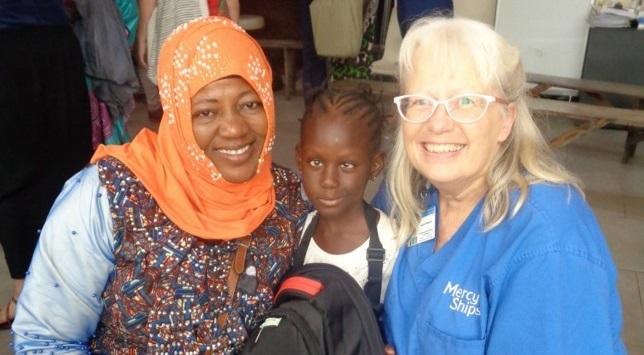
For Laura Klassen of Niverville, charitable giving has taken on a far deeper meaning than just reaching into her wallet. On Easter Sunday, Klassen returned home from an eight-month volunteer tour with the Mercy Ships of Africa. This was her fourth such adventure in seven years.
Mercy Ships is a charitable organization that brings trained medical personnel to countries which are underserved in affordable healthcare services. Their goal is to bring hope and healing to some of the world’s poorest by docking a hospital ship off the coast of countries that need help. In the years that Klassen has volunteered, she’s served as a nurse in Madagascar, Benin, and Guinea.
“It really opens up your horizons and your world,” Klassen says. “It’s changed my perception of the world and my [level of] compassion.”
Klassen began volunteering with Mercy Ships in 2013, only four years after receiving her Licensed Practical Nurse (LPN) certification.
“I’ve always had Africa in my mind,” says Klassen. “It just sounded like a big adventure… I saw the Discovery Channel show about the Mercy Ships… It was all about the ships and how they have to look out for pirates and it just sounded like a lovely adventure.”
Only once in her four years of service, though, has one of her ships ever had a concern about pirate infiltration. Typically, the ship is docked on the coast of the African mainland and doesn’t leave until it returns to Spain for drydock during the summer months.
Once, in Klassen’s experience, the ship headed to Madagascar to serve the people of the island. This was one of Klassen’s more memorable experiences.
“It was very interesting,” she says. “The Indian Ocean is very rough and this ship is actually a converted train ferry so it’s flat. It’s not like cruise ships that have a bow. So, when it comes down [from a wave] it just slams. I was seasick the whole time, unfortunately.”
It was also on this trip that Klassen had to confront the prospect of a pirate attack. While it didn’t occur, the ship’s captain instructed all those aboard on what to do in the event of such a scare. A predetermined code word was to be spoken over the PA system and each volunteer was then to lock themselves in their sleeping quarters until they were told it was safe to exit.
On all four excursions, Klassen was assigned to the eye team, a group of specialists providing eye surgery for children and adults. Many surgeries involve the removal of cataracts, a problem that exists more frequently in African countries due to constant exposure to bright sunlight and dust blowing in from the Sahara Desert. The team performed about 16 surgeries every day for ten months.
As an LPN, Laura worked in pre-surgery, giving patients eyedrops and checking their vital signs. One of the most difficult jobs, she says, was sending patients away when their blood pressure and sugar levels were too high. They were instructed to see a doctor on the mainland to help correct these problems, then return for another try once their vitals were under control.
“Some of the [patients] travel from quite far to get [to us] and then they’ll just stay in the city wherever they can,” Klassen says. “A lot of them will just sleep on the street.”
She recalls one desperate woman who returned time and again only to be sent away. On her last return, just two days before the surgical team was preparing to quit for the season, Klassen turned to her deep faith, asking God to help this woman’s vitals be strong enough to clear her for surgery. They were and Klassen rejoiced in an answered prayer.
Another memorable patient for Klassen was a 13-year-old who had been rendered almost blind. When the girl first arrived, she was aggressive and violent, striking out at pre-surgery staff. After a surgery to restore her vision, she was a different child, tranquil in the face of her new lease on life.
While eye correction has a prominent place in the surgical units, other medical ailments are addressed as well. The ship’s hold contains five operating rooms, each run by a volunteer surgeon specializing in different fields.
Within these operating rooms, bones and cleft pallets are repaired, tumors removed, and gynecological problems corrected. Burn injuries are also quite common, many of them on small children since local mothers cook their meals over an open flame while keeping their little ones within reach.
Most young patients are accompanied through the surgical process by caregivers who have to make their own sacrifices within the ship’s four cramped recovery rooms.
“There was minimal space, so the [patient’s] caregiver would sleep under the [recovery] bed to save space,” Klassen muses.
The Mercy Ships organization also provides volunteer services beyond the ship’s hull. Palliative care workers provide aid in the local city. The medical staff holds mentorship programs for local doctors and nurses, better equipping them to perform the same surgeries in their own facilities. The organization has been instrumental in renovating and equipping local hospitals and dental offices, which has helped reduce the number of patients needing to wait for treatment on the ship.
During any given year, the ship houses about 200 day crew, most of them volunteers from around the world. This number also includes local translators paid by the organization.
Volunteer staff don’t need to have medical credentials to provide aid. They arrive each year for varying lengths of time to provide housekeeping, food services, communications, hairdressing, and education for on-board children. Mercy Ships welcomes volunteer families with young children as well, the kids benefiting from the unique foreign experience and, hopefully, becoming future volunteers themselves.
For Klassen, forging friendships with volunteers from around the world has been one of the biggest rewards. Two of Klassen’s closest friends are now from Holland and Alaska. She has also built Facebook friendships with some of her African patients who regularly send joyful videos of their post-surgery advancements.
“What’s nice about working with the Mercy Ships is getting to know the… [local] translators, because you get to go to their home and sometimes their churches,” Klassen says of her weekend excursions onto the mainland.
She describes African churches as loud, happy places with lots of dancing. There are times, though, when foreign visitors aren’t necessarily welcome.
“We went to a drum-making village and there were some little kids that had never seen a white person, so they were afraid of us,” Laura laughs. “That was a little funny. They would scream when they saw us.”
Klassen says her Mercy Ship experiences wouldn’t be possible without financial assistance from her church, family, and friends. She’s also thankful for her employer at Bethesda Place in Steinbach, a long-term care facility, who gives her the leave every couple of years to do this.
“They have been gracious enough to give me four leaves of absence,” Klassen says. “There are many people who work for Mercy Ships that have to quit their jobs to go because they couldn’t get a leave, so I’m very grateful.”
These experiences have fueled her desire to travel and experience different countries and cultures. She imagines that, eventually, she might find new ways to volunteer her skills, but for now there is still much of West Africa she has yet to see.
And each time she returns home, she has to face the challenge of re-acclimatizing to the affluent North American lifestyle.
“If I can share my [overseas] story… it makes the transition easier,” Klassen concludes.