


It’s been six weeks since The Citizen published the news that a major AI data centre is being proposed for Île-des-Chênes (IDC).
In the newspaper’s monthly poll in January, we posed the following question: “Are you concerned about the size, scale and energy and water usage of the proposed data centre in Île-des-Chênes?”
This question garnered more public feedback than any other in the paper’s ten-year history, and a clear consensus prevailed: there is no room for industry like this in IDC.
A small minority did point to its potential economic benefit.
Since the story first broke in mid-December, a group of IDC homeowners have banded together in the hopes of snuffing the data centre flicker before it becomes a flame.
For this group, at present composed mostly of homeowners bordering the property, the data centre poses more than a threat to their homes and community. They say it reeks of “city ties” while destroying “country skies.”
Family Land
The 350-acre parcel of land lies to IDC’s north, bordered by Mondor Road to the north, Arnould Road to the east, Highway 405 to the south, and Swerdyliak Road to the west. The section contains seven residential properties.
The site map published by Jet.AI, one of the data centre’s corporate ownership groups, draws neat lines around these private properties, making the section look like a puzzle with a few pieces missing.
Chris and Mona Hardie and Matt Howard own two of these properties.
Immediately outside the section lies approximately a dozen other residential properties. Mona’s brother Gilles Hogue owns one. Christie Little owns another. A third is owned by Andrè and Rhonda Hudon.
Mona and Gilles have a history with this land that goes back nearly three generations. The siblings’ maternal grandparents, the D’Auteuils, were responsible for donating much of the land on which IDC currently sits. It includes greenspace now known as D’Auteuil Park.
Their paternal grandparents, the Hogues, owned land north of IDC, including that on which Mona and Gilles now live and part of the acreage being proposed for the data centre.
“This land has been in our family for a long time,” Mona says. “We have very deep roots here and I take that seriously. We want to continue that for our next generation.”
Grandfather Hogue eventually sold 240 acres of the land to his two sons, one of whom was the father of Mona and Gilles. After the siblings claimed their stakes, the father eventually sold his portion to an outside buyer.
The remaining 120 acres still belong to the family of their deceased uncle.
There is a third title on the 350 acres, although they are unsure who currently owns it.
At this stage, with little information available, it’s unclear how close the data centre’s ownership group is to assuming title of the three parcels of connected land. This kind of industry, though, is certainly not what they believe their forefathers had in mind. Likely, their grandparents anticipated that IDC’s residential neighbourhoods would continue to grow northward.
That’s certainly what Gilles had in mind when he tried to subdivide his large acreage into a series of roadside residential lots bordering Mondor. He was confident there were others, like him, who’d love to live on large multi-acre properties south of Winnipeg.
For all his attempts, though, he was told by previous RM councils that it would never happen in his lifetime. The land was zoned for agricultural purposes and that’s how they wanted it to stay.
And thus, the land here has remained agricultural. It provides stunning vistas of golden wheat and vibrant sunflowers, thanks to the farmer who rents it.
Over the years, the bucolic setting has attracted other residents, like the Hudons, Littles, and Howards.
“I have no plans to move,” says Matt Howard. “I’m here for the long haul. We moved here because we didn’t think there’d be anything around us. Maybe residential eventually, but never an AI data centre.”
Now, with the potential for an industrial building large enough to accommodate “hyperscale tenants,” of which Microsoft and Google would qualify, these locals foresee problems, including lower property values.
Christie Little is one of them. As a real estate agent, she says that she’d absolutely have to disclose the potential risk to prospective buyers if one of her clients wanted to buy one of these properties. They would have a legal right to know about the potential changes ahead.
Extensive Concern
All the residents interviewed by The Citizen agree that their concerns go far beyond the development of land in their literal backyard. If such a project were to be approved, they say, it would affect IDC as a whole, not to mention the region, province, and country.
Rhonda Hudon is a veterinary technician by trade. She raises a cow, chickens, ducks, sheep, and bees on her acreage at the corner of Mondor and Arnould.
“My worst fear was when [the farmers] would spray the field and my cow was in the backyard,” Rhonda says. “That’s the only thing I had to worry about.”
Animal lover that she is, she worries not only for her own livestock but for the future of Wildlife Haven, a rehabilitation centre existing just south of the proposed data centre. Could light pollution, noise pollution, and resource consumption from the data centre affect them negatively? She believes it would.
Her husband Andrè is focused on the environmental impacts.
“[An AI data centre] consumes so many resources—electricity and natural gas, water, and land,” he says. “We’re taking away good farmland when there’s a cry in the world for more food. The emissions [it] will give off alone are greater than [that of] the city of Winnipeg in a year. If the federal government wants to hold me accountable for the stuff that I put back into the environment, why can’t I hold them accountable?”
Little agrees with him.
“Those AI data centres have huge impacts,” Christie says. “Almost all of the universities have done studies on the impacts and none of it is good.”
Some of those impacts were cited in The Citizen’s December article, based on historical data collected from other AI data centres around the world.
Jet.AI’s promotional materials suggest that six turbines will be necessary to run the data centre as proposed.
For Chris Hardie and others, this will likely result in a constant audible drone that is disruptive to humans and animals on both a physical and mental level.
The centre also promises to be a drain on the region’s natural resources, they say. Already IDC deals with regular power outages. Adding the power needs of a massive industry will only exacerbate the problem unless Manitoba Hydro first commits to improving local infrastructure on a major scale.
Probably of greatest concern, though, is the immense strain that a data centre could put on one of the region’s most essential resources—water.
According to Water Security News Wire (WSNW), AI data centres are water guzzlers and the risks they pose to humanity are still being widely ignored.
They contend that some regions surrounding existing data centres already experience increased water scarcity. Studies have shown that a small one-megawatt data centre can use up to 26 million litres of water per year. This equates to the same average consumption of 62 American families.
“The international community lacks a clear understanding of data centers’ impacts on water resources,” reads a report from WSNW, “as there are no uniform regulatory requirements for data center operators to track and report their water use.”1
For Gilles, who’s lived in the area his entire life, the story of big industry pushing its way into residential communities isn’t new. He saw it before when the TransCanada Corporation, known today as TC Energy, built their natural-gas transmission and distribution station on IDC’s north end.
It took a lawsuit from a local resident, Gilles says, for the company to put mufflers on their system in order to buffer off-gassing noise that sounded like fighter jets over the community.
There’s still a propane gas smell that occasionally drifts over from the plant, the group adds.
For Gilles, it’s once burned, twice shy.
“That big Goliath should have never been built [so close to a community],” says Gilles. “Same with this [data centre].”
And that’s exactly why the group of residents means to educate the public on the hazards of the data centre proposal, in the hopes of stopping it before it grows legs. Once these big companies put down roots, they say, they won’t be uprooted.
“Put it in an industrial area where there’s a bunch of buildings already,” Christie says. “Or go even further up north where agricultural land is not as sustainable.”
Mayor Ewen Responds
Over the past weeks, the group has been sending emails to politicians at all levels, as well as Manitoba Hydro. So far the responses they’ve received have been vague at best, suggesting that there’s little to comment on until Jet.AI begins a formal process.
Since then, however, Ritchot Mayor Chris Ewen has responded to a variety of the concerns expressed.
Like the others, Ewen acknowledges that he knows very little about the data centre proposal. Back in October 2025, he was approached by data centre reps who came to inquire about land in the area. They provided few details and no drawn-up plans for such a facility.
Ewen says that part of the 350 acres of land they have their eyes on was rezoned years ago in order to accommodate a cryptocurrency mining company that wanted to build there. The company never followed through with their plans.
Apart from that small section, Ewen says that council has never entertained any other industry with designs on this area.
“It’s never been a part of Ritchot’s plan to develop this land, residentially, commercially, or industrially,” Ewen says. “Our council’s [mandate], during the last nine years, has always been to protect agricultural land.”
Even now, he puts little stock in the data centre inquiry. On a monthly basis, he says, he receives phone calls from franchises and corporations inquiring about locating in Ritchot. In the majority of those cases, it ends there.
“I could lie to you and say that this is a priority for me, but it’s not, because it hasn’t come to us yet,” Ewen says. “Once it comes to council, then it becomes a priority.”
When and if this proposal does come to council down the road, members of council would evaluate it according to a number of criteria.
First and foremost, Ewen says, they will look at the effect the business could pose in terms of land use and nearby residents. As well, they will question its employment potential, economic benefits, and environmental impacts.
Most projects of this magnitude, he says, take many years to go from the proposal to completion stage.
For now, Ewen recommends that residents do their own due diligence if they’re concerned about the data centre’s potential.
If the proposal comes to a public hearing in the future, he adds that council will be looking for residents to come forward with fact-based evidence. He points out that council has been swayed in the past by large numbers of residents who stand opposed to a project.
Bottom of the Hierarchy
Even with Ewen’s reassurances, the group still wonders just how much power Ritchot’s council will have at the end of the day. In Canada, municipal governments are accountable to provincial governments and they, in turn, are accountable to the feds.
In the past year, both higher levels of government have publicly stated their intent to help pave the way for the AI industry in Canada.
To do so, the federal government developed the Canadian AI Compute Strategy, which will provide $2 billion in funding to help mobilize private sector investment and help construct public supercomputing infrastructure.
Premier Wab Kinew was equally vocal about his government’s endorsement of the creation of local data storage infrastructure initiatives. The goal, he said, is to make Manitobans less reliant on U.S.-based tech giants like Google and Microsoft.
The IDC homeowners take little comfort in this. The corporate group looking at the IDC location, Convergence Compute, is owned in part by Jet.AI, a Nevada-based company.
Based on a public announcement to investors last summer, Jet.AI says that the IDC proposal is already garnering interest from hyperscale tenants who are looking to produce AI-related services on a massive scale.
For Mona Hardie, saying yes to this company would be akin to selling out to U.S. interests. If endorsed by the province, she feels it would fly in the face of Kinew’s major selling points.
Mike Winston, founder and CEO of Jet.AI, has spoken with great optimism for the two data centres his company hopes to construct in Canada, including one on the east coast and one in IDC.
“Overall, we’re encouraged by the progress and believe the odds of success for both projects have now moved in our favour,” said Winston in a 2025 public release.
FOR MORE INFORMATION
1 “AI Data Centers Threaten Global Water Security,” Water Security News Wire. December 23, 2024 (https://watersecuritynewswire.com/treatment-security/2024/12/23/ai-data-centers-threaten-global-water-security).
To read the original story, visit: https://nivervillecitizen.com/news/local/major-ai-data-centre-proposed-…
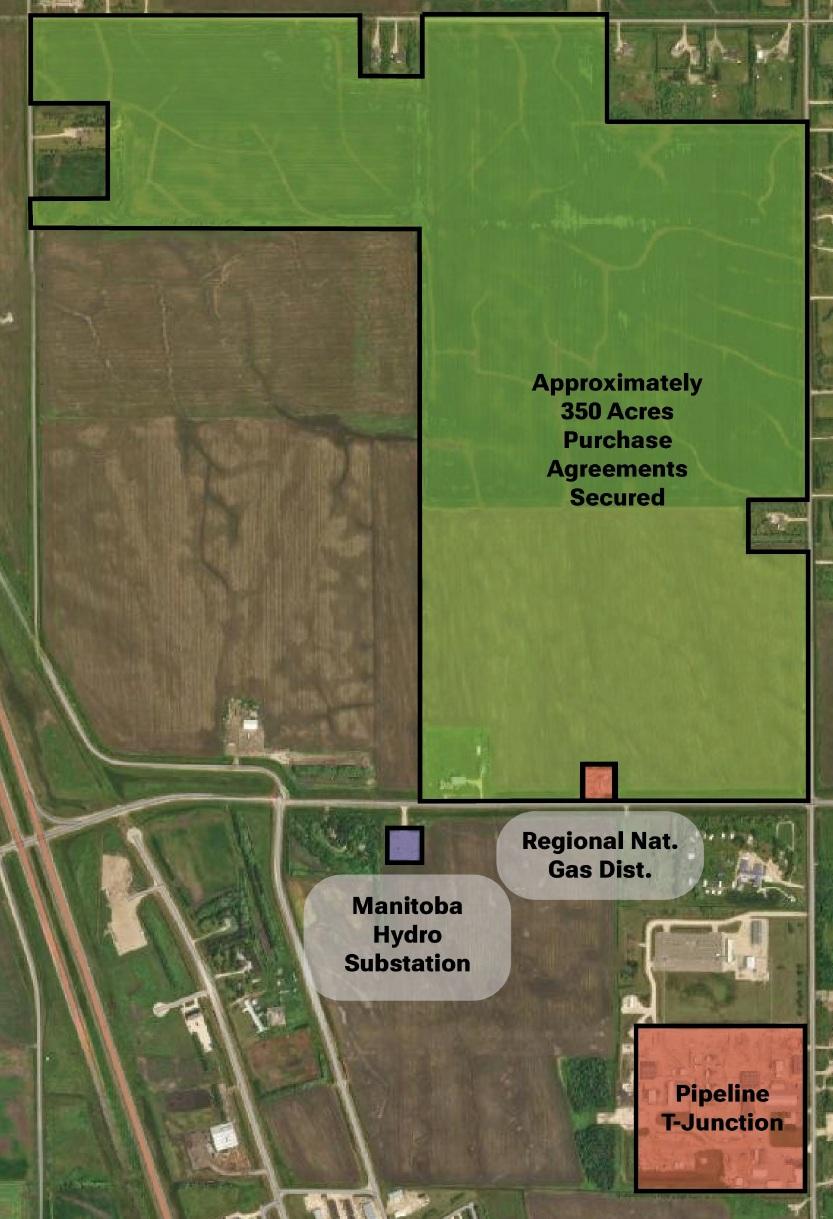
The proposed location of the data centre.