

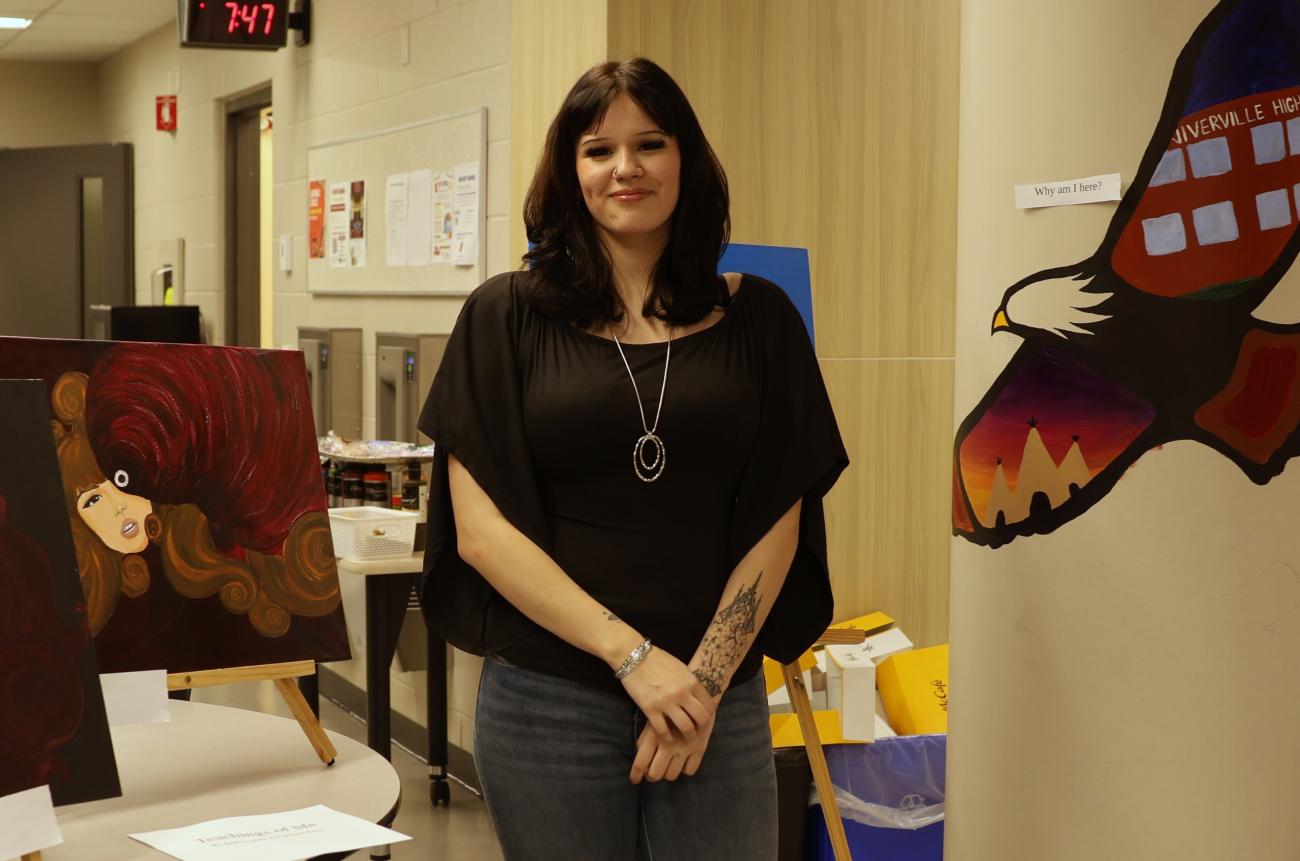
To look into the soul of an artist, gaze upon their art. On January 29, 30 Niverville High School (NHS) students from Tony Clark’s Grade 12 art class put their souls on canvas for the world to see, with inspiring and thought-provoking results.
Clark has been teaching art for the better part of two decades. Every year since NHS opened, the graduating class has been showcasing their work through a public art show. Clark says the event was inspired by the school’s first principal, Kimberley Funk.
“This night is such a big night because it’s an authentic audience,” Clark says. “It’s an amazing experience for them. They did all the PR, all the snacks, and all the setup. I’m just here for moral support.”
With this much free rein, the students pulled out all the stops, inviting political leaders, media, professional artists, family, and peers. Each student had five pieces on display.
Their mediums varied, depending on their interests and passions, from painting to sculpting, pottery to mixed media, and quite literally anything that felt like a creative outlet.
While Clark’s job is to encourage skill-building and creativity, he says he loves to watch for emerging patterns in each student’s art and help them recognize what their inner voice may be telling them.
“You think what you’re doing is just a random, but this is what came out of your heart over and over again,” Clark would tell his students. “This is what you’re interested in and you really want to talk about.”
To Clark, art is a dialogue. It not only tells the artist’s story but evokes a story in the beholder. In the end, these two stories may not be the same, but the art itself opens a door to mutual dialogue, something that feels lacking in the bigger world right now.
He encourages freedom of expression but reminds his students to practice provocative imagery with caution, always keeping the viewer in mind.
To challenge themselves, each Grade 12 student was expected to try their hand at mural painting, using a four-by-eight-foot plywood sheet as their canvass. These completed pieces will find a long-term home on the exterior of the Centennial Arena for all to see.
Sarina Jafari
Sarina Jafari has only been in Manitoba for six months. Jafari, her mother, and siblings lived the last eight years in India, having escaped Afghanistan when the Taliban took over. It was in India that Jafari learned English and developed her artistic creativity.
While her favourite medium is charcoal, for the plywood mural project she put her skills to work on acrylics for the first time. The result is a piece she calls “Buzkashi,” depicting Afghani horsemen in pursuit of a goat. It’s a popular sport in her home country, she says, and one that women and girls weren’t free to participate in, or even watch.
Another is called “Evolution.” This is an abstract piece done in monochromatic tones of charcoal. It’s a self-portrait, she says.
“An Afghan girl faces a lot of restrictions from the Taliban,” says Jafari. “They are not allowed to laugh loudly or go out without a male. They’re not allowed to get an education. I feel like they’re trying to erase women from society. So I see this girl as getting erased, but she is trying to put her identity back together. I see a fighter in this one.”
Following graduation, Jafari plans to attend the University of Manitoba to pursue a degree in medicine. She’ll continue to use art as a way to express herself.
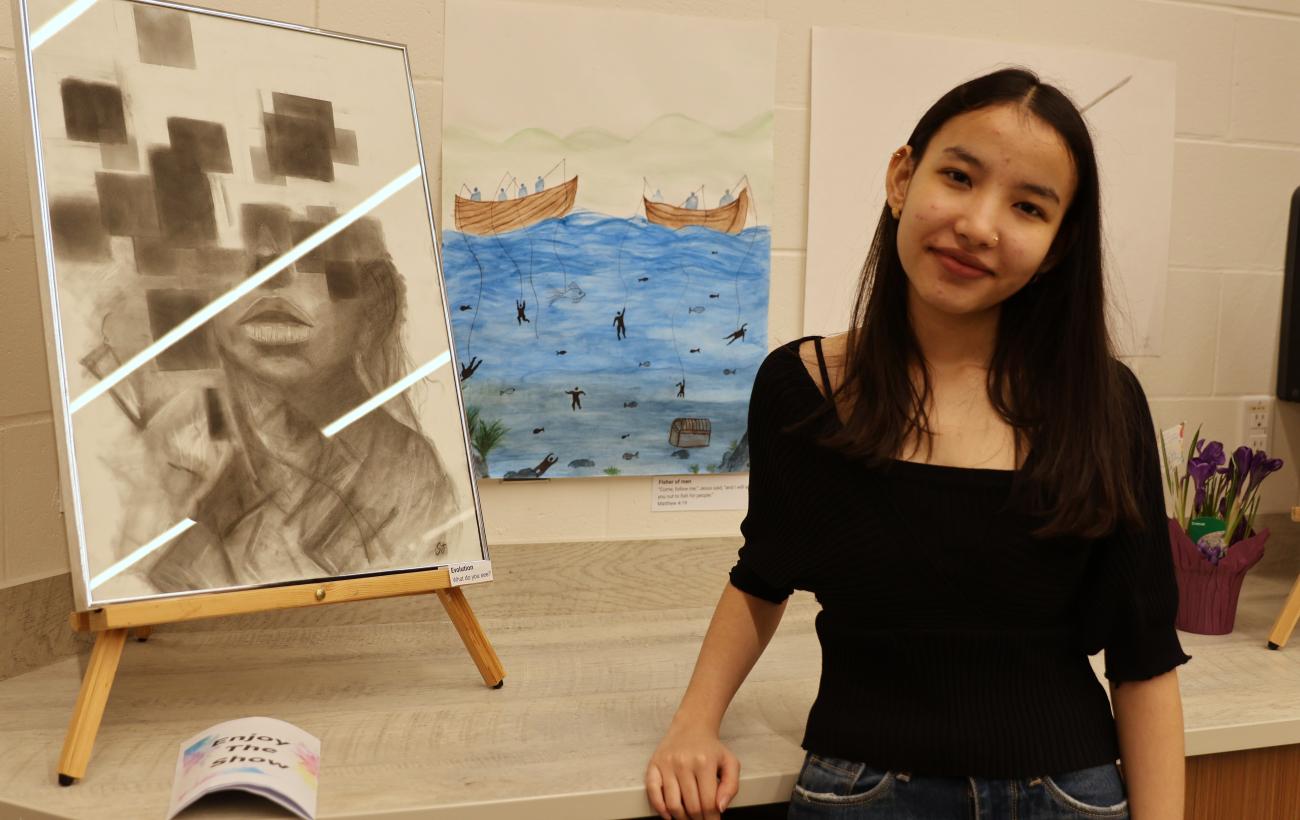
Sarina Jafari, senior at Niverville High School.
Jaelle Lundy
Jaelle Lundy comes by her gift naturally. Her mother is an artist as well as a couple of her siblings. Her favourite medium is paint.
Together with fellow student Londyne Enns, Lundy pitched the idea of painting Indigenous art on the four pillars that line the NHS foyer.
Both Lundy and Enns come from an Oji-Cree background. Their fathers were Sixties Scoop survivors.
“We wanted to bring the voice of Indigenous students into the school,” Lundy says. “We wanted something big and bold and based on the seven teachings of our culture.”
The seven teachings, they explain, are humility, honesty, courage, wisdom, love, truth, and bravery. At the same time, through artistic imagery, the duo incorporated the four guiding questions as posed by former senator and Truth and Reconciliation leader Murray Sinclair: “Where do I come from? Where am I going? Why am I here? Who am I?”
“We wanted it to be not just for Indigenous students but something that everyone could relate to,” Lundy says. “The seven teachings of life can [resonate] with anyone. Also, it’s not just for the present but something that [will still matter] in the future.”
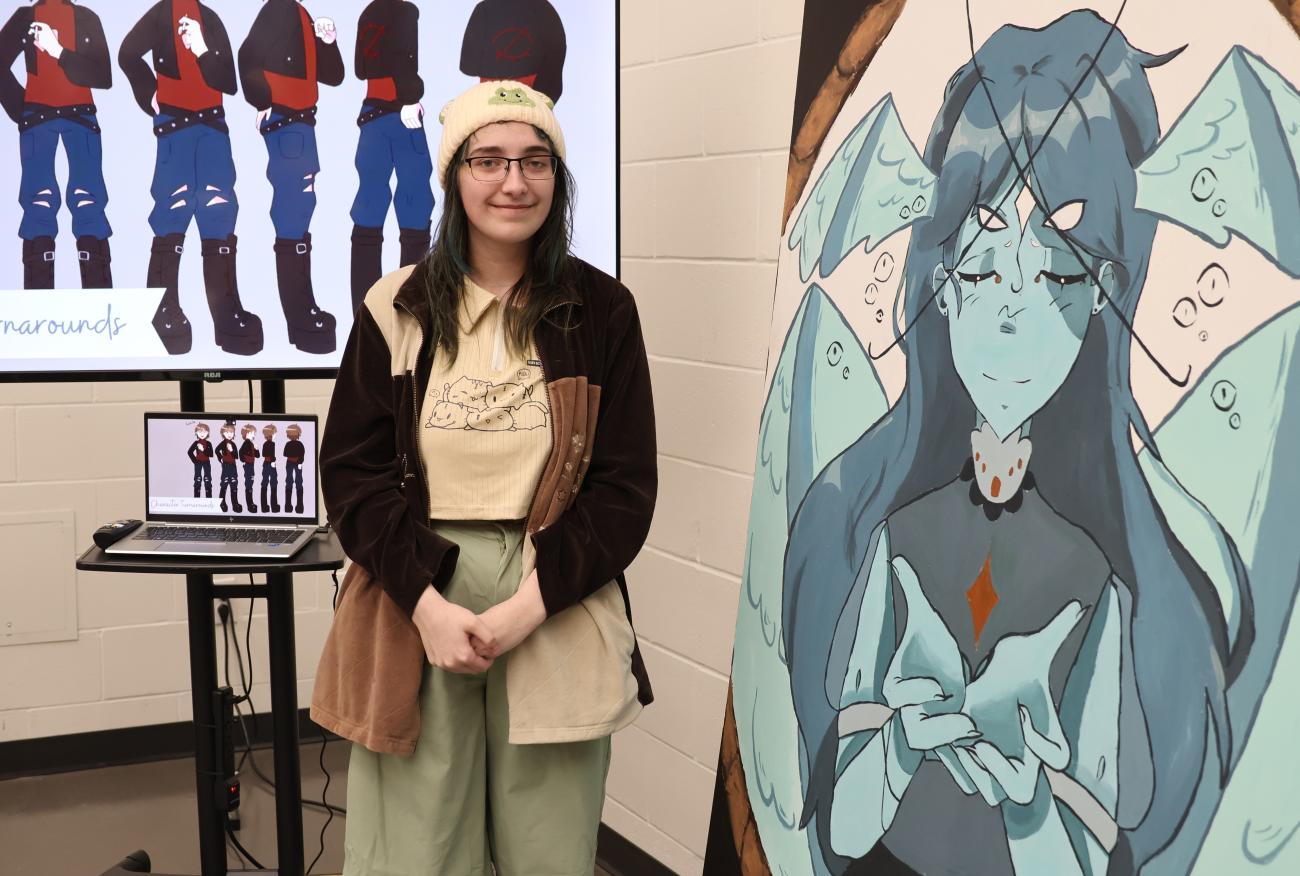
Luka Prociw is a senior at NHS.
Luka Prociw
Luka Prociw is a graphic novel designer and digital artist. His mural display was his first foray into acrylic painting.
“This is a piece I made based on my own thoughts and feelings of suicide,” Prociw says. “The angel inside of the noose is supposed to [represent] that feeling of coaxing, that urge to harm yourself.”
Prociw lost his mother a few years back and admits to struggling with suicidal ideations and self-harm in past years. For Prociw, art has become the healing outlet that’s helped him move through his dark places to find peace.
Following graduation, he hopes to pursue a degree in animation at a college in Ontario.