

If all goes as planned for one corporate tech collaborative, Île-des-Chênes (IDC) will soon be home to Manitoba’s first major AI data centre. Jet.AI, a Nevada-based provider of GPU (graphics processing unit) infrastructure and AI cloud services, made their formal public announcement on December 4.
Jet.AI has joined with Consensus Core Technologies Inc., a company from Vancouver offering similar services, to form Convergence Compute. Their intent is to open at least two new AI data centres in Canada.
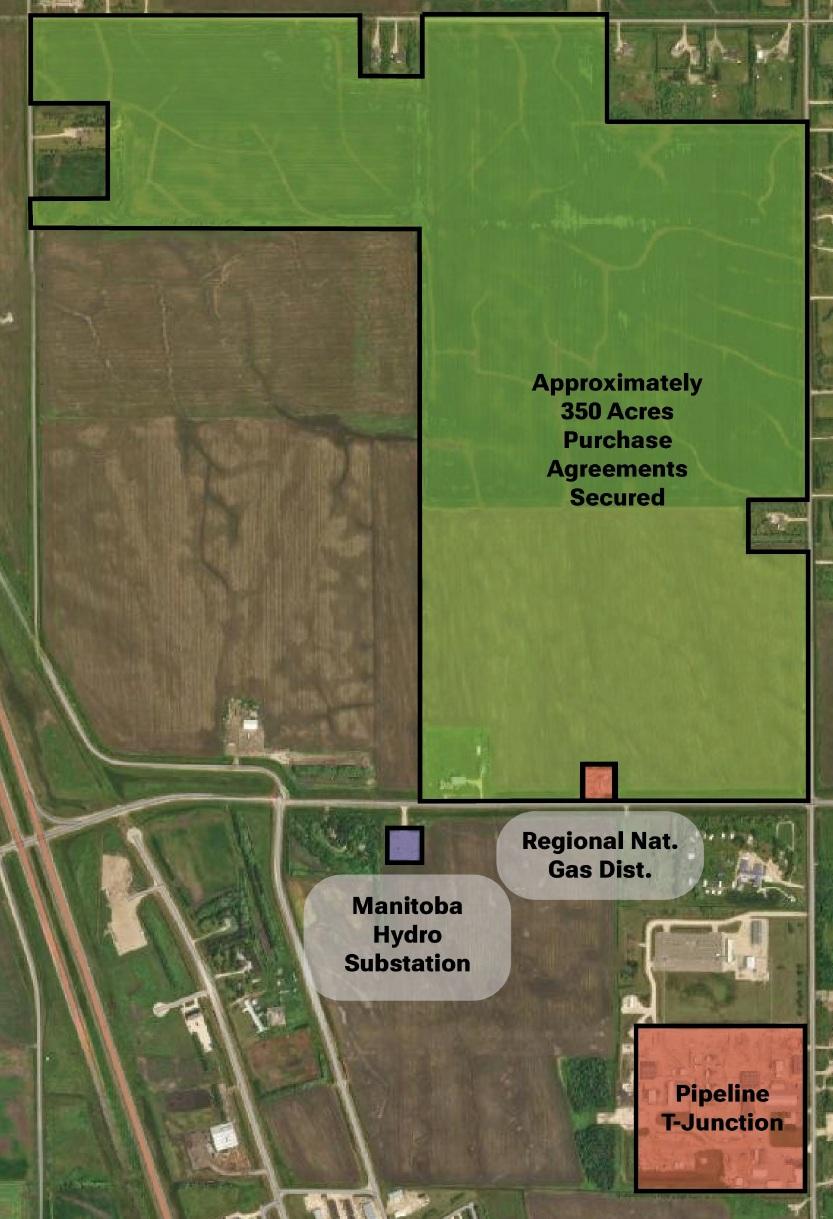
The Midwestern Project, scheduled for construction on 350 acres of land on the north side of IDC, is described by Jet.AI as “a large-scale development designed to meet rising North American demand for AI and high-density compute.”
Already, they say, the proposed Manitoba campus is garnering interest from hyperscale tenants looking for the kind of infrastructure in which AI-related services can be produced on a massive scale.
A second major AI data centre, dubbed the Maritime Project, is in the works as well, presumably somewhere along the east coast.
“The energy and natural resources we need are already present in abundance at our sites, and the next milestone is about turning that advantage into action,” says Mike Winston, founder and CEO of Jet.AI. “We’re making sure we don’t just have places to build data centres, but also the energy commitments to make them run. Overall, we’re encouraged by the progress and believe the odds of success for both projects have now moved in our favour.”
Also propelling their odds of success is the provincial government’s recent endorsement of Manitoba-based data storage infrastructure initiatives. The goal, Premier Kinew said in a speech to the Manitoba Chamber of Commerce, is to make Manitobans less reliant on U.S.-based tech giants like Google and Microsoft.
Greater domestic capacity, he added, would help protect Canadians’ privacy and allow enforcement under Canadian law.
“How do we keep your privacy so that our kids and grandkids will be able to develop as individuals and have that freedom to express themselves in a way that is truly free in the future of our society?” asked Kinew. “Well, it probably means that we should stop sending all of our information south of the border.”1
So far, the RM of Ritchot is maintaining a wait-and-see stance.
“To date, nothing has come before council for consideration,” the RM communications coordinator told The Citizen. “Until something is presented, it would be premature for us to provide a comment.”
Rare Find
Jet.AI’s promotional material for the Midwestern Project describes IDC as a Goldilocks site for data centre development. An important component is finding a large tract of land, and locating 350 contiguous acres bordering key energy infrastructure is a relatively rare find.
According to a site map provided by Jet.AI, the land is situated between Arnould Road and Highway 59 to the east and west. North to south boundaries include Mondor Road and Highway 405, also known as Van Gorp Road.
Of strategic importance, too, is the availability of local cost-effective energy sources. Data centres require substantial energy inputs to power their advanced cooling systems and maintain reliable backup supports.
Six operational turbines are expected to be required to run the Midwestern Project.
The parcel of land in IDC sits adjacent to a Manitoba Hydro substation, the Riel Converter, with a hydroelectric transmission corridor running directly overhead.
Immediately south of the site lies one of Canada’s principal long-haul natural-gas transmission and distribution stations, TC Energy, providing direct access to a second reliable power solution.
“As AI compute demand accelerates, energy-advantaged sites like this are becoming increasingly difficult to secure,” says Winston. “The combination of power, redundancy, and buildable scale here is extremely hard to replicate.”
Not to be dismissed, too, is the nearby high-speed fibre internet corridor which can provide the data centre with large bandwidth volumes which are critical for computing operations of this scale.
“This site aligns with the long-term compute and energy profile the industry is moving toward,” says Wayne Lloyd, CEO of Consensus Core. “It offers the reliability, connectivity, and acreage required for multi-phase hyperscale deployment.”
Having achieved their first and second milestones of finding and securing land, Convergence Compute has moved on to completing milestone number three.
“For the Midwestern Project, the submission of the Transmission Power Load Study application is substantially complete,” says Jet.AI in a November 14 press release. “We have made significant progress in securing confirmation from the natural gas utility supplier to provide sufficient flow to operate the six proposed turbines. Conversations with the natural gas utility supplier are ongoing and we do not expect their confirmation to present any bottlenecks.”
As for the Maritimes Project, Convergence Compute says they are working on acquiring needed energy from a proposed wind farm.
Canada Holds Promise
According to a Norton Rose Fulbright Data Protection Report, thanks to energy infrastructure, policy landscape, and its environment position, Canada is uniquely poised as a desirable location for AI data centre development.
“AI data centres require large amounts of electricity to power high-performance hardware such as GPUs,” the report states. “As demand for AI and cloud services grows, this is driving a sharp rise in energy use by data centres.”2
In 2024, they say the transmission of data consumed somewhere between one percent and 1.4 percent of the world’s electricity use. The International Energy Agency expects this number to more than double in the next four years.
For this reason, large tech companies are looking to sign long-term contracts with local energy providers who are providing rates that are, on average, lower than many other developed countries.
“In addition to high electricity demands, AI data centres also generate significant heat as a byproduct of powering AI-related hardware,” the report continues. “Managing this heat… is critical to maintain system performance and prevent hardware failure. Canada’s cooler ambient temperatures could help reduce the need for these energy-intensive cooling systems, thereby resulting in lower operational costs.”
Also fuelling the interest in Canadian prospects is the federal government’s Canadian AI Compute Strategy, introduced late last year.
This strategy will result in $2 billion in funding over the next five years to help mobilize private sector investment and build public supercomputing infrastructure.
Potential Risks
As AI data centres emerge around the globe, so too does news of the exponential threat they may pose to one of the world’s greatest natural resources: water.
According to Water Security News Wire (WSNW), an online source for water industry professionals, AI data centres are water guzzlers and the risks they pose to humanity are still widely ignored.
Already it’s at the point, they say, where some regions are experiencing increased water scarcity. As demand for AI increases, however, the industry is expected to soon surpass other water-intensive industries such as cattle and textiles.
“The international community lacks a clear understanding of data centres’ impacts on water resources as there are no uniform regulatory requirements for data centre operators to track and report their water use,” says WSNW.3
Why the high consumption of water? In many data centres, it’s used as a coolant to help maintain manageable temperatures for the high heat-producing computing equipment.
Drinking water is optimal for use since it’s already free of impurities that could corrode server systems.
Water consumption can be slightly minimized by investing in closed-loop cooling systems that limit evaporation. Unfortunately, they are more expensive to install than open-loop systems.
So far, studies have been able to determine is that a small one-megawatt data centre can use up to 26 million litres of water per year. This equates to the same average consumption of 62 American families.
Right now the average annual use by data centres across the entire United States is the same as the average annual water consumption of two million families.
Even with this knowledge, data centres are appearing rapidly around the world.
“Developing economies have prioritized data centre expansion to advance national digital transformation and digital sovereignty goals, benefiting transnational tech corporations,” says WSNW. “In addition to gaining access to new markets, these corporations are often incentivized or rewarded… through tax subsidies, low-cost real estate contracts, and promises of minimal monitoring.”
But the effects are also being seen in advanced economies.
The freshwater consumption of a Meta-owned data centre in Virginia shows a 250 percent increase in the area’s water use since 2019. This has resulted in drought-like conditions for residents.
Meta’s plans for a new data centre in the Netherlands have been met with massive public opposition, primarily based on its potential to impact groundwater reserves.
In states like Oregon and countries like Chile, citizen action groups are similarly responding to Google’s data centre initiatives.
In 2024, the EU set a new precedent which imposes water and energy use reporting on data centres operating in their region.
“Meanwhile, local utilities and elected representatives, incentivized by tax subsidies, enter into confidentiality agreements with corporations that limit information-sharing,” says WSNW. “These postures ultimately undermine accountability and public trust, while pushing already stressed water resources into further precarity.”
The Citizen reached out to a Jet.AI investor relations representative for a comment regarding some of these tough questions. No reply was forthcoming.
REFERENCES
1 Steve Lambert, “Manitoba Premier Wab Kinew Endorses Call for Servers, Data Centres to Be Built in Province,” CBC. October 31, 2025 (https://www.cbc.ca/news/canada/manitoba/ai-report-servers-9.6962507).
2 Imran Ahmad, Domenic Presta, and Sandeep Patel, “Canada’s Place in the AI Data Centre Boom,” Data Protection Report. July 14, 2025 (https://www.dataprotectionreport.com/2025/07/canadas-place-in-the-ai-da…).
3 “AI Data Centers Threaten Global Water Security,” Water Security News Wire. December 23, 2024 (https://watersecuritynewswire.com/treatment-security/2024/12/23/ai-data…).