

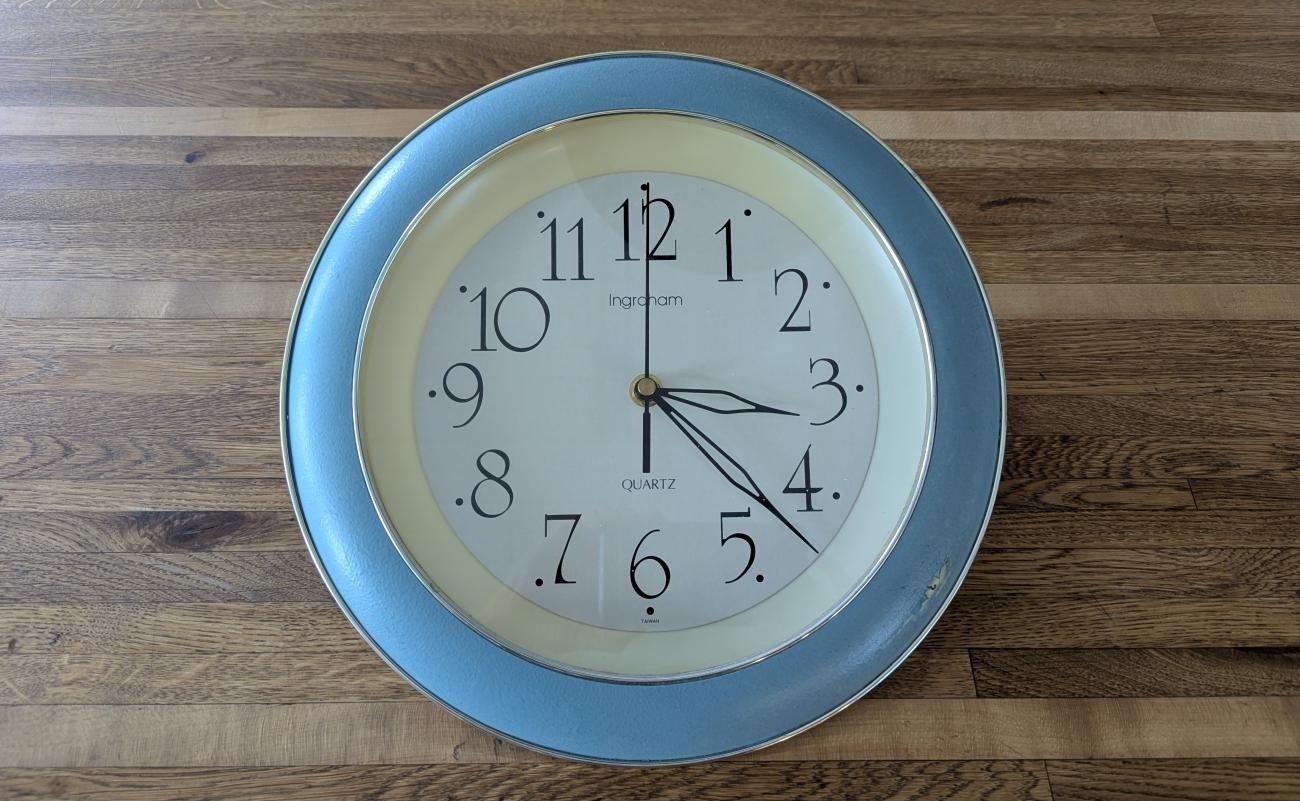
On May 20, the provincial government extended an invitation to all Manitobans to share their views on the long-held tradition of seasonal time changes. Should the province shift away from the practice of a biannual clock adjustment? They’re also seeking input on whether the majority would opt for permanent standard time or permanent daylight time.
“Across Canada, a number of provinces and territories are ending the time change and Manitobans have made it clear they want us to look at doing the same,” said Glen Simard, Minister of Municipal and Northern Relations. “From a lower risk of stroke to when the sun rises and sets, there are a number of things to consider, and we want to hear directly from Manitobans.”
According to the province, a report by Manitoba Health concludes that a shift away from seasonal time changes would be better for everyone’s overall health.
Springfield-Ritchot MLA Ron Schuler has been pushing the provincial government to make this move for some time now.
“Manitobans are tired of losing an hour of sleep and gaining nothing in return,” Schuler said in a press release last year. “In fact, research clearly shows that time changes increase the risk of heart attacks, strokes, workplace accidents, and lost productivity. It’s time to stop changing the clocks and leave this outdated practice in the past.”
A similar sentiment seems to prevail among locals, and that’s especially true for parents of young children and farmers whose livestock operate on inflexible schedules.
If the practice of seasonal time change were to be dropped, an apparent majority appear to agree that daylight time is the one to keep year-round. This scenario would create an extra hour of evening daylight during the summer months.
Approximately 62 countries around the globe participate in some form of daylight savings tradition, including Canada, the United States, Australia, France, Germany, and the United Kingdom.
The origin of Daylight Savings Time (DST) goes back more than a hundred years. Canada began observing the practice in 1918, immediately after similar legislation was passed in Germany and Britain. The hope was that a shift in daylight hours would help increase production for wartime efforts.
In Canada and other countries, DST was dropped after the end of World War I.
However, the practice quickly resumed when World War II got underway. Many countries established different protocols. Great Britain, for instance, moved clocks ahead one hour during the winter months and two hours in the summer months.
The close of WWII, however, didn’t mean an end to DST. Although the practice continues in North America to this day, Canada’s federal government eventually gave some authority to the provinces, territories, and municipalities regarding its implementation.
In 1966, most of the province of Saskatchewan stopped observing DST, as well as parts of western Quebec, Ontario, and British Columbia. In the U.S., two states don’t participate: Arizona and Hawaii.
Before 2005, the clocks were changed in early April and late October. That year, U.S. President George W. Bush signed legislation to change the dates to March and November. Canada followed its neighbour’s lead.
The rationale? To reduce energy consumption, since people wouldn’t need to turn their lights on as early in the evening. Little data has been provided to support the effectiveness of this approach.
SHARE YOUR FEEDBACK
To register your thoughts on time changes, visit: https://engagemb.ca/time-change