

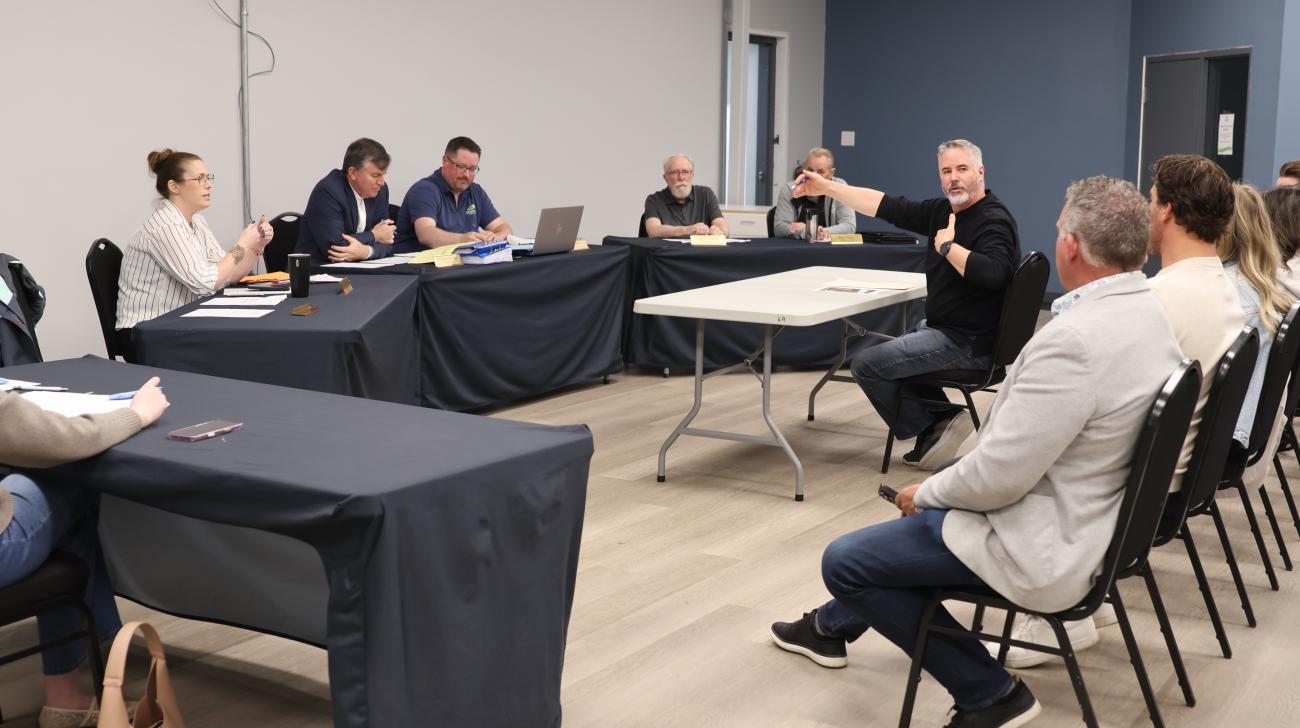
Residents gathered on May 19 in council’s temporary chambers at the Centennial Arena to voice concern over a planned high-density housing campus. The development is proposed for 243 Sixth Avenue South.
Developer Kaden Reimer sought council’s approval to construct row housing that would provide 90 rental units. This includes 44 two-storey townhouses with garages as well as a series of walk-in townhouses. The campus would include a playground and basketball court for tenant use.
Council voted unanimously in favour of approving the conditional use application.
The lot in question is bordered on the west side by well-established single-family dwellings along Edelweiss Crescent. For the most part, these are the residents who stood opposed.
Based on the east-to-west orientation of the planned units, one Edelweiss resident shared concerns over the potential for a constant stream of headlights shining into their east-facing windows.
“This is bringing the city to our backyard,” he said. “Maybe something smaller would be [better].”
Councillor Meghan Beasant reminded attendees that this proposal fits the model of high-density housing better, perhaps, than a multi-storey apartment block.
Mayor Myron Dyck offered assurances that council’s development plan attempts to prevent those kids of disparities in residential areas.
“We try to do a one-storey step-up from zone to zone,” Dyck said. “So if the one zone is single-storey, the next dense zone could only go to two-storey.”
The same neighbour also worries about a public basketball court in close proximity to his backyard. At minimum, he suggested, council should consider asking the developer to install a fence that is higher than six feet.
To this, the developer clarified that the basketball court and playground would be contained in the centre of the campus, providing greater distance from the homes on Edelweiss.
Drainage was of concern to another resident, an issue that CAO Eric King said that the town had already considered.
“Sixty or seventy percent of the water will go towards Sixth, which is a massive improvement over what happens there currently,” said King. “The goal is to improve the ditch… along Sixth because that has lots of capacity.”
A representative for the developer confirmed this.
“Currently over 60 percent of that land drains towards Edelweiss,” he said. “[The town] has negotiated really tough with us. They’re only allowing us 10 percent, so they’re forcing us, at no small expense, to move 90 percent of the water towards Sixth Avenue.”
Also predetermined by council is the need for the developer to contribute towards a future set of traffic lights at the corner of Main and Sixth Avenue. This would only happen, though, once the province deems that traffic levels warrant it.
A few attendees were quick to query about the future of Spruce Drive. While it only serves residents of Roselawn Bay and Edelweiss Crescent right now, they asked whether there are plans to extend it through to Sixth Avenue, thus turning it into a thoroughfare.
“No would be the short answer for now,” said CAO Eric King. “And you guys would have the opportunity to speak to it if that [is ever proposed].”
Making that change would be an arduous process, King explained, since the privately owned land between Spruce and Sixth doesn’t currently have a road allowance connected to it. It would also require the approval of a subdivision application by the landowner.
“Someone buying that property would have to sacrifice part of that land for a road and, when everyone’s worried about cost per door, I don’t know that they’d want to be buying land to build a road,” Mayor Dyck said.
As the public hearing drew to a close, Dyck elaborated on why council might vote in favor of this kind of development proposal.
“On the other side of Sixth Avenue, there are ag producers,” Dyck said. “They are encouraging density because they know that [otherwise] the ask will suddenly be of them for the land they’ve been producing on. And so we have this tension that exists in urban development between density and trying to keep ag land as ag land.”
He also added that people need to start recognizing that the small town feel they’re pining after isn’t about numbers. Rather, it’s about culture.
“Our 40-year forecast, based on the growth that we’re seeing, is 28,000 [people],” Dyck said. “So what are our options? Stop and close the door? The developers will leave, the businesses won’t come here, and we risk that the average [home] price of $400,000 [will drop].”
Beasant suggested that residents look outside of Niverville’s borders when considering housing density options close to home.
“One of the biggest crises across the world is housing right now,” Beasant said. “That’s not going to go away. There’s so much research that shows that a lack of housing is actually a stepping stone and catalyst for so many other issues that we’re facing in the world.”