

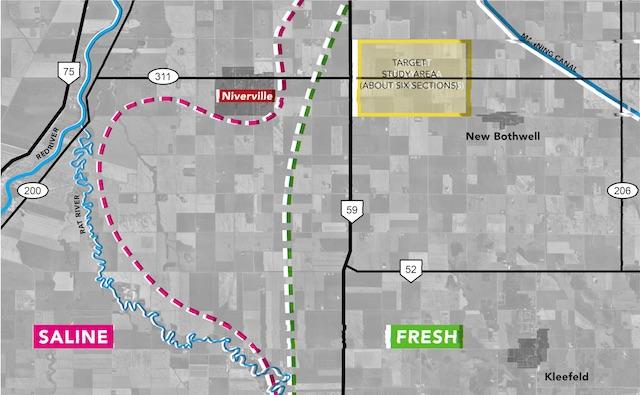
One year ago, Friesen Drillers of Steinbach teamed up with Landmark Planning & Design Inc. (LP&DI) of Winnipeg and the Manitoba Water Services Board to locate a new well site for Niverville, commissioned by the town council. Today, after extensive public consultation, permit applications, research, and test drilling, a new well site has been located approximately one mile west of New Bothwell. A public open house was held at the Niverville Heritage Centre on April 19 to present their findings.
The Town of Niverville became aware of issues with the existing wells servicing the Spruce Drive water plant in 2016. The wells, located near the plant, were originally constructed in 2002 and were found to be unable to keep up with the demand of the growing community. Due to the higher pump volumes required, the sand within the well had begun to lift, causing treatment and turbidity issues and overtaxing the plant’s ability to filter the water adequately.
Recognizing that the town would soon be in need of treated water for businesses along Main Street, and eventually the whole community, council took quick action to address the concern.
The two- to three-year process of locating and constructing a new well site is now well underway.
“These wells were selected… as the most likely and most promising locations for a proposed water supply,” says Jeff Bell, hydrogeological engineer for Friesen Drillers. “The preliminary testing revealed a highly fractured bedrock in these locations, and a good connection to the aquifer.”
Two wells have been selected and proposed for Niverville’s use, one as a backup in the event that the first pump should fail. Though the site lies approximately 11 kilometres from the town’s border, much consideration was given in determining the best possible location.
Sand and saline content is higher in the groundwater west of Highway 59 towards the Red River. Thus, the target study area led the research teams east of the highway, where the water in both aquifers is fresh. Other determining factors included the number of existing wells in the area and the impact a new well would have on agriculture and other communities.
Eight test wells were drilled and a total of 32 wells in the area were monitored during the testing. Friesen Drillers undertook pump test procedures well beyond what is legally required in order to confirm the viability of the site. They determined that the capacity of the test wells were very high, and adequate flow rates appear to be possible without causing any negative impact.
The results collected from the variety of studies and tests will now be compiled into a report for the provincial government. The resulting provincial review will determine whether a license will be granted or whether new test sites need to be sought out. According to the research companies, the province of Manitoba will not allow any groundwater extraction that is not sustainable.
“The Water Rights Act allows for the province to allocate groundwater use for groups in the province,” says Bell. “This is done through a licensing process and review. Their process is well thought-out and extensive, and requires water use to be done sustainably. A new project in an area cannot negatively affect the water rights of another, or affect the domestic uses of the residents in the area.”
Bell says that one of the aspects of the Act is a first-in-time, first-in-right clause, which allows those who first gain access and license to a well site to have first rights to it. The province has ultimate authority over all groundwater, similar to minerals located beneath the surface of all provincial property.
“In the southeast, we are all very fortunate with the aquifers that we have available to us,” says Bell. “There are two aquifers in the southeast, and these are large regional aquifers that extend beyond the U.S. border, through the Interlake, and past The Pas. There is a limestone aquifer and an underlying sandstone aquifer.”
Bell adds that in the past 10 to 20 years, water levels have risen in the southeast, allowing for quick recovery after pumping. Because the aquifer in the test area is protected by low-permeability sediments—a natural buffer for nitrates, coliforms, or elevated chlorides caused by human activity—there is cleaner groundwater from which to pump.
Friesen Drillers and LP&DI pride themselves in the methods they use to educate the public throughout the process. Landowners within the target area were paid personal visits to create awareness and alleviate concerns. To date, two open houses have been held in Niverville to inform the community and likewise allay any unease.
“As far as a water supply project goes, there is no requirement for us to engage in this type of public involvement and public consultation,” says Bell. “This type of approach was developed for these projects by our team. We feel it is [important] to increase people’s knowledge and understanding of the process, and allow them the chance to see [and] take part in all aspects [of it].”