

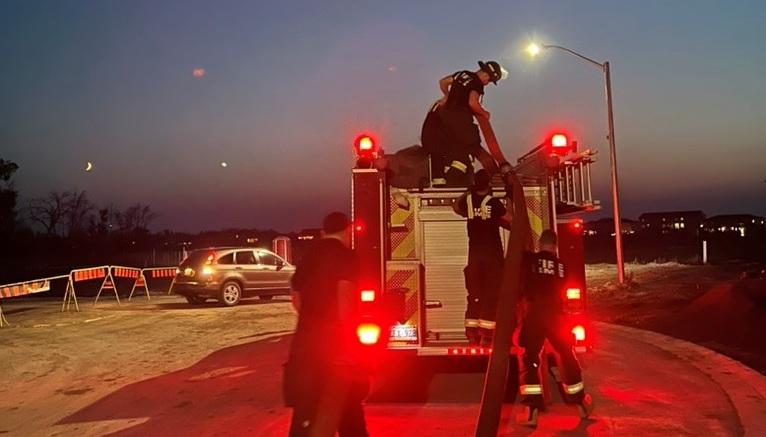
According to Keith Bueckert, chief of Niverville Fire and EMS, 2025 was by far their busiest year on record. In all, the team responded to 347 calls. That’s up by about 20 percent from the year before.
Of these callouts, 258 were medical calls, outnumbering the 89 fire calls by a wide margin.
When you consider that the team of 40 paid on-call volunteers serve only the Town of Niverville, it means that about five percent of the community’s households sent out calls for fire-related concerns. As well, almost four percent of local residents needed some kind of immediate medical intervention last year.
If the trend continues, 2026 will result in similar numbers. Niverville Fire and EMS has already responded to 21 calls in the first two weeks of January.
As far as fires are concerned, Bueckert says there were no situations of homes being engulfed in flames last year. The calls they did respond to were investigations of carbon monoxide detector alarms going off or a neighbour witnessing unidentified smoke. The crew dealt with small structure fires, kitchen fires, and vehicle fires.
“We were very lucky that we didn’t have anything serious fire-wise,” Bueckert says. “We had a bunch of small fires, but there was nothing with huge losses value-wise. That’s really encouraging for a community of our size.”
In part, he says, this could be attributed to the 15 or more years of fire prevention education they’ve provided to the community, beginning with the town’s school-age residents.
It’s also likely due to the fact that the fire team perform regular inspections of public buildings and seniors’ facilities to ensure safety measures are up to snuff.
Of course, when you have a rapid response time like Niverville’s fire crew, any small fire attended is a large fire prevented.
Another great fire prevention measure, Bueckert adds, are monitored fire alarm systems. In recent years, he’s seeing more of these in Niverville homes.
“[When] the alarm goes off in their house, it goes to a monitoring company and generally within 90 seconds we’re being notified,” Bueckert says. “And we’re usually on scene within six to ten minutes, depending on the time of day.”
Unfortunately, the department responds to their share of false alarms, too. Bueckert says an actual fire is always presumed until an onsite inspection proves otherwise.
There are ways for homeowners to help prevent these unnecessary calls. First, make sure you hire a reputable alarm company to monitor your system. Also, ensure that smoke alarms are located close to the bedrooms and not as close to the kitchen or bathroom shower. With today’s sensitive smoke alarms, even steam can trigger a response.
“Generally, the most common false alarm in our community are those where somebody needs to replace the battery in their [monitored] smoke alarm,” says Bueckert. “They take the battery out and that triggers an alarm.”
If you have a monitored system, Bueckert advises that a quick call to the monitoring company ahead of time is all it takes to prevent an unneeded fire department response.
As for EMS, Bueckert says the majority of calls were medical-related and not necessarily involving trauma. He describes medical calls as involving situations of chest pain and shortness of breath, feelings of being off, and instincts that suggest that something’s not right.
Trauma-related injuries would be, for example, falls that result in broken bones or concussions.
“We don’t see a lot of calls for trauma-related injuries in town, so that’s always a good thing.”
Other calls that Bueckert and his team rarely encounter are mental health issues resulting in behavioural emergencies. He’s thankful, too, that they get virtually no emergency calls resulting from drug use, unlike Winnipeg EMS, who deal with this on a daily basis.
So who are these local heroes who comprise Niverville Fire and EMS? The majority, if not all, are Niverville residents.
Approximately 15 of them work full-time in emergency services somewhere else and then apply these same skills, after hours, in town. The rest work full-time jobs unrelated to their emergency volunteer work.
The majority of Niverville’s emergency team are trained in both fire and EMS, allowing them to work both sides of the system as needed. The can carry various medical certifications, such as emergency medical responder, primary care paramedic, and advanced first aid.
“We just hired six individuals and, of those six, five of them are trained,” Bueckert says. “So that helps us out a lot, so we don’t have to provide it. That’s a huge advantage for us because that [otherwise] becomes a cost for the department.”
It’s not just emergency calls that eat up volunteer time. When you include the many hours spent in training and educational efforts, the crew logged 618 different events into their schedules last year. All of these were hours spent over-and-above the 258 emergency callouts.
Of course, Bueckert is all too cognizant of the many family members who stand behind each and every volunteer. He himself is a family man.
“I just want to thank the families. Their lives get put on hold at times and I don’t think they get enough credit for the part they do to support our members.”
In the coming years, Bueckert and his team are hopeful that a new fire hall will become a reality. Council is working on design plans and a budget. It’s a facility, Bueckert says, that’s long overdue.