

For the second year in a row, the Manitoba Mennonite Historical Society (MMHS) is commemorating the arrival of the first Mennonite settlers by hosting bus tours of the major points of significance on both the East and West Reserves.
While the West Reserve tour is fully booked, the MMHS invites history lovers of all stripes to join them for the East Reserve tour on June 27.
Tickets for the all-day excursion are selling for $60 per person. The day includes a seat on a chartered bus, a Mennonite-inspired lunch, and the historical storytelling of Conrad Stoesz, president of the MMHS, and Ernie Braun, MMHS board member.
“Being on location, you get a better sense of [the story],” says Stoesz. “It’s a different way of learning history, a little more tangible than just a textbook or listening to stories or even seeing it on film.”
The East Reserve tour runs from the banks of the Red River eastward to Steinbach. Participants will be picked up at the north grounds of the Canadian Mennonite University at 8:30 a.m. and returned by 5:00 p.m.
The first stop will be the Mennonite Memorial Landing site near Niverville at the confluence of the Red and Rat Rivers. Participants can also choose to begin their ride here.
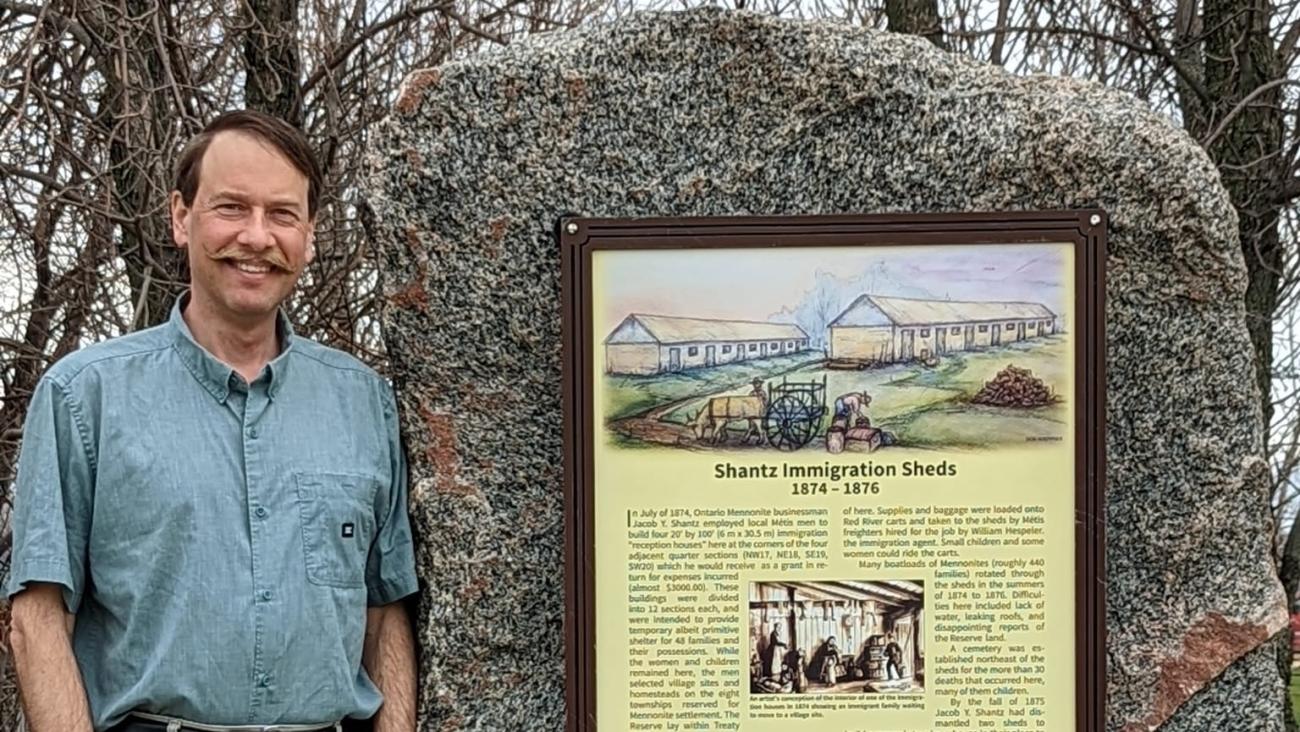
The tour will include the Schantz sheds cairn, a stop in Niverville at the site of the ox cart used by early settlers, as well as a series of other significant sites en route.
At the halfway point, participants will break at the Chortitz Heritage Church for lunch. This church in Randolph is the gathering place of one of the first Mennonite congregations in western Canada. The building dates back to 1897.
Tour participants will enjoy far more than just interesting historical sights, though. Both Stoesz and Braun are storytellers who plan to keep everyone engaged through the telling of heartwarming and tragic tales of Mennonite migration.
Stoesz recounts one story of young Margaretha Esau. At the tender age of four, Margaretha went down in history as the first Mennonite immigrant to die on Manitoba soil.
As the story goes, Esau’s family was on a train, headed from their home in Ukraine to England where they would board a ship bound for Canada.
“On the train, she gets yanked by the conductor off the train and she falls and hits her head on a stone,” Stoesz says. “From then on, her health is not good. The [family] arrives by ship at the Red and Rat junction on August 1 and goes to the immigration sheds. Margaretha dies on the third of August in 1874.”
With no cut wood to build the young girl a coffin, the family solicited the help of local swimmers to retrieve a plank which was afloat on the Red River. With only bare essentials, they fashioned a box in which to lay her body.
According to Stoesz, 30 unmarked graves lie at an unknown location somewhere just west of Niverville. This site holds some of the earliest Mennonite immigrants, like young Margaretha.
Another story with a less tragic ending is that of 67-year-old Johann Schroeder. Schroeder and his family were also at the English port that day, ready to board for their trip to Canada.
Schroeder, having very poor eyesight, relied on the guidance of his young son Jacob to help him navigate the busy port. Over the father’s shoulder was slung a huge bag of dried bread known as reischja, which would sustain the family on their arduous journey across the ocean.
Unfortunately for Schroeder, his young son became so transfixed by the busyness of the port, the ships, and the machinery that he failed to vigilantly guide his father along the way.
“Johann is walking up the plank [to the boat] carrying this bag of reischja and holding Jacob’s hand,” Stoesz says. “Johann missteps and he falls off the plank and into the water below, pulling his son in with him. Jacob is able to grab hold of a bar, and he’s looking around for his dad who doesn’t know how to swim. But because Johann is holding the bag of reischja, it acts like a life preserver and so he is saved by it.”
Stoesz says stories like these have been trickling down from generation to generation since the time of the first Mennonite’s arrival. Thanks to the work of the Mennonite Heritage Archives (MHA), where Stoesz is employed, these stories are being written down for posterity.
The Plett Foundation has been instrumental in supporting the East and West Reserve bus tours.
Stoesz encourages people to get their tickets soon as each tour is limited to about 50 people.
PURCHASE TICKETS
For tickets or to learn more information, visit: https://mmhs.org