

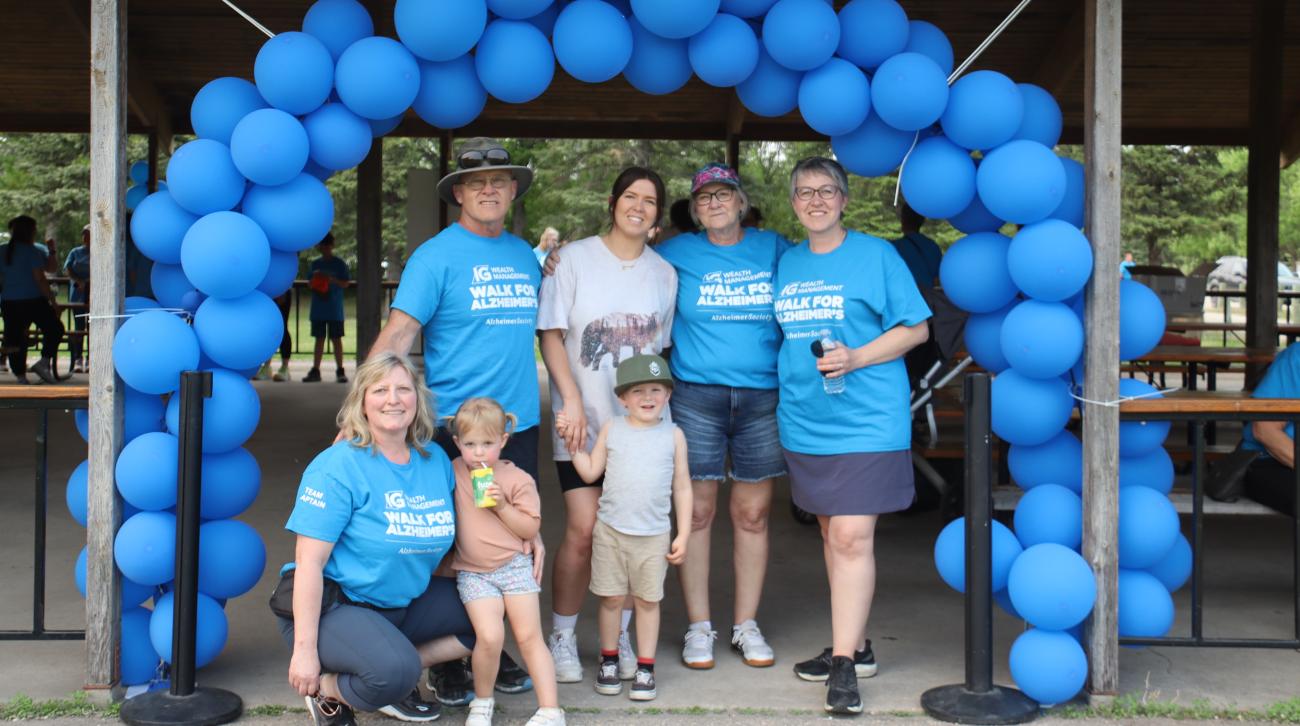
As the last remnants of winter fade, the Alzheimer’s Society of Manitoba (ASM) is encouraging everyone to get outside and walk—more specifically, to walk in the IG Wealth Management Walk for Alzheimer’s.
Since 1993, the ASM has been inviting people to join their annual fundraising campaign and assist them in delivering the needed tools and resources to the more than 20,000 Manitobans affected by dementia, plus their families and caregivers.
These resources include one-on-one support, education sessions, and dementia-friendly programming.
This year’s fundraising goal is set at $315,000.
In total, seven Walk for Alzheimer’s events will take place around the province throughout May and June.
Assiniboine Park’s Lyric Theatre will be the location for the Winnipeg walk on Saturday, May 30 at 10:00 a.m. Steinbach will host theirs on Sunday, June 7 at 12:30 p.m. at the K.R. Barkman Park.
More than just a fundraising campaign, the Walk for Alzheimer’s provides an integral opportunity to connect Manitobans facing the same dementia challenges and show them that they aren’t alone.
Last year’s event drew more than 1,300 walkers across the province.
“Too often, people navigate a dementia diagnosis all on their own,” says ASM CEO Erin Crawford. “The Walk really helps you to see that thousands of Manitobans are being impacted by the exact same thing at the exact same time. Nine Manitobans per day are diagnosed. Those people will be so much better off if they can see their community showing up for them.”
Crawford says that the number of dementia sufferers is expected to double by 2050. Across Canada, close to 800,000 people are estimated to be affected.
This total doesn’t include the caregivers and family members who help navigate this frightening disease. In reality, virtually every Canadian is currently being touched, or will eventually be touched, in some way.
While it’s generally considered a disease of the aging, certain dementias already affect adults at midlife. For instance, frontotemporal dementia, which was actor Bruce Willis’s diagnosis.
“It starts to develop probably already in our twenties and thirties,” says Crawford. “We just don’t see the full impact of it until much later.”
Alzheimer’s is still the most common dementia diagnosis. First signs usually include short-term memory loss, although a certain cognitive fogginess with age doesn’t necessarily point to the presence of the disease.
Signs to watch for, Crawford says, are acts of thoughtlessness: dressing improperly for a weather condition or putting the toothbrush in the refrigerator.
Disorientation is another common factor, often resulting in situations where the sufferer loses their directional bearings in a location that should be familiar to them.
A person’s communication skills might also suffer. This could manifest in someone struggling to formulate a cohesive sentence.
Behavioural issues could arise, for instance, when a gentle-natured person becomes suddenly and unexplainably aggressive.
Regardless of symptoms or degree of impairment, the ASM is there with guidance, support, and education to help manage life in the best way possible.
Some of the funding raised by Alzheimer’s Societies across the country also goes to helping fund research.
“There have been some really exciting developments in terms of treatments,” says Crawford. “We have, for the first time ever, disease-modifying therapies.”
Unfortunately, she says, the drugs may not be broadly accessible to the average person for some time. As well, they need to be started at a very early stage of development. Just the fact that they exist, though, is cause for hope that further therapies will follow.
Treatment is only one part of the equation, she adds. More research is taking place in terms of lifestyle shifts to help avoid dementia in the first place, including the effects of diet, exercise, and social connection.
“There is still a frustrating lack of knowledge in understanding and treating dementia, and really moving the needle significantly. That just tells us how important it is to keep going.”
FOR MORE INFORMATION
To register for the Walk for Alzheimer’s: www.alzheimer.mb.ca/wfa
To learn more, visit the ASM on Facebook (@AlzheimerSocietyManitoba) or Instagram (@alzheimermb).