

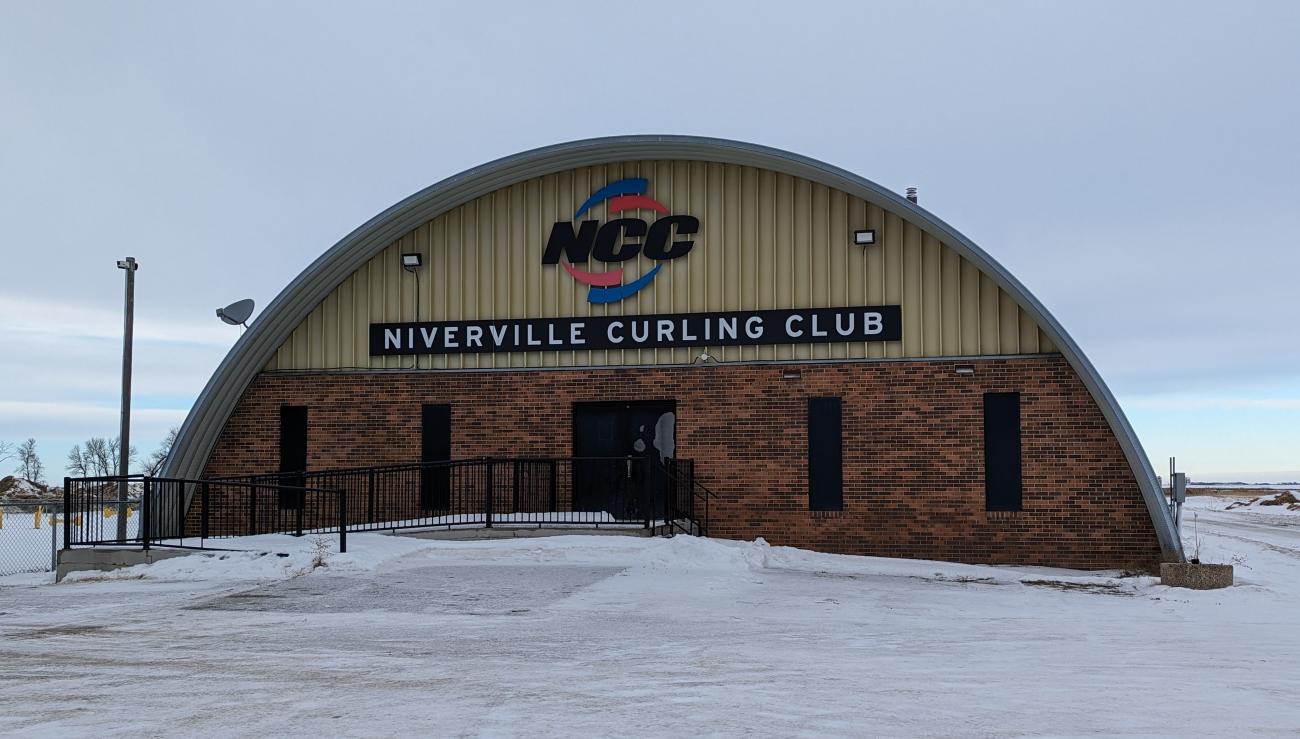
Nearly a century of curling has come to an end in Niverville. And for the Niverville Curling Club (NCC), it’s not a happy goodbye.
According to Dustin Krahn, president of the NCC, the town is entering into a lease agreement with a private business that intends to repurpose the curling rink, a decision that leaves the NCC out in the cold.
For the 2026 season, the NCC will rent space in St. Adolphe. The future beyond that is up in the air.
At the time of this writing, no official paperwork between the town and the new leaser had been signed. However, the legalities were in process.
According to Niverville mayor Myron Dyck, the leasing group presented an opportunity that council had not gone looking for. Still, the offer was timely and appeared to be the best short-term solution for a building in need of so much repair.
The biggest frustration for Krahn and the NCC wasn’t that council looked to other leaseholders. The NCC, after all, were themselves leaseholders for the coldest months of the year.
In fact, bringing in user groups for the rest of the season was the best possible solution for the facility’s long-term viability. With some thoughtful planning, budgeting, and renovations, Krahn adds, the building could have been vastly improved.
Krahn says that’s what NCC has been asking of council for years: to collaborate in the development of a long-term vision for the curling rink and its other amenities, which include a common room with a canteen and a basement gathering place with tables and a kitchen.
While there had been some conversations with council this past fall, in hindsight Krahn feels that the process was disingenuous.
“In late September, this was proposed as an idea to coexist with a potential new business, but somewhere along the way it turned into a contest where only one of the groups would be granted use of the facility,” Krahn says. “We were not notified that we were expected to pitch a case for our own survival. We interpreted the invitation to council’s planning session as a positive thing, the start of the conversation we’d been asking for, and not as an invitation to our own funeral.”
Now the NCC feels slighted. Not only had the club been using the facility for almost 50 years, they’d also been contributing their own time, labour, and money to run the curling program. In 2023, they invested $15,000 in upgrades to the facility’s kitchen. More recently, they offered to replace a broken furnace at no cost to the town.
Still, Mayor Dyck says those costs barely scratch the surface of the issues facing the building if curling remains its primary use.
“The building needs to be insulated,” says Dyck. “It needs a concrete floor and it needs an ice plant.”
Council’s Defence
One could certainly argue about the need for an ice plant. The NCC has been functioning on a natural ice surface since 1978, albeit with shorter seasons.
According to Dyck, its functionality will only continue to decrease with time.
“The largest fact the town has to address is the facility being incapable of dealing with a warming winter climate,” Dyck says in a letter to the NCC. “Just this week we saw temperatures of plus-four. Looking back at historical trends, our below-zero days have dropped by 40 days.”
According to CAO Eric King, the town has invested $87,000 in capital improvements to the facility over the past ten years.
As it stands right now, keeping the building in use as a curling rink costs between $12,000 to $20,000 per year.
While some provincial or federal grants exist, King says they don’t cover the cost of overhead. The town did receive one-time funding from the province to improve accessibility to the building.
Other ongoing funding exists, such as the Building Sustainable Communities grant, which covers 50 percent of eligible project costs up to $75,000 and up to $300,000 for large capital projects.
The St. Adolphe Curling Club benefited from this grant to the tune of $15,000 during the 2022–23 season.
At this stage, though, Niverville’s council has determined that the best way forward is to bring in a year-round leaser. In the meantime, this helps council stay focused on their goal of paying off the CRRC debt by 2028.
In a few short years, Dyck says council will be faced with another dilemma, that of the Centennial Arena needing massive upgrades or closing altogether due to an outdated ice plant that no longer meets regulations.
According to Dyck, Niverville is not the only community struggling to keep its curling culture alive. For this reason, he believes regionalization of facilities may be the answer.
“Council made the decision to see the potential for a regional curling club to succeed rather than two local chapters work against each other,” Dyck says, referring to the St. Adolphe curling rink.
Krahn would argue that the NCC’s league has been full every year with a waiting list for the past five years, despite the rink’s shortcomings. He can only imagine what numbers could become if the facility were improved.
For a community growing as rapidly as Niverville, Krahn feels it’s short-sighted to provoke the death of a long-time institution like curling. He worries that once local curlers move on to other facilities, it will be hard to get them back without promising a brand-new facility similar to the CRRC.
Dan Giesbrecht is one of those people. He’s been curling in Niverville since he moved here about 15 years ago.
Giesbrecht describes the Niverville curling experience as casual and the people as very welcoming of players of any skill level, including those new to the sport.
He wasn’t deterred by the shorter playing season required with natural ice. Two months of play, he says, is long enough.
“Curling’s been popular in Niverville for a long time,” Giesbrecht says. “I know the club has been busy three or four nights a week during the season that we run and there’s always people there. That’s why it’s a shock that there hasn’t been more planning on how we keep curling going in Niverville. It feels like it’s coming to an abrupt end.”
History of the NCC
With the early curling pioneers of Niverville mostly gone, it’s hard to pin down a definitive year when the sport took off in the community.
Long-time resident George Sawatzky is fairly confident, though, that the NCC has been around since the 1940s. He and his wife moved to Niverville in 1965. The original curling rink, then located at 85 Second Street South, was already an older facility when they arrived.
Sawatzky joined the curling club as a way to get active and get to know the locals. He describes the early building as a Quonset-style structure with three sheets of ice and a viewing gallery. It ran as a cooperative with members holding shares. The town was not involved.
In the late 1970s, the property was sold and some of the proceeds went to the construction of a new curling rink. The new building, which remains to this day, was constructed next to the Centennial Arena.
The building was constructed by volunteers and built on charitable donations. But since its real estate was town-owned, the town held title.
Even so, management of the facility was left in the hands of the NCC.
Gary Stott served as president of the NCC at the time. His love for the sport began as a child when he accompanied his father to the original rink.
According to both Sawatzky and Stott, volunteers have always been the backbone of the NCC. That never changed over the years.
Like Stott, current NCC president Dustin Krahn has been volunteering and playing at the Niverville rink since he was a child.
Until about 2010, the town’s primary role was to cover the cost of utilities and insurance. Beyond that, the town provided virtually no oversight.
Later, their involvement evolved into that of a landlord, leasing the building to the NCC for part of the year. Still, the NCC took responsibility for many of the incidentals like annual internet services, septic tank cleaning, and icemaking supplies.
During the 2025 curling season, the antiquated rink furnace finally broke down. The estimated cost to replace it came to $10,000. In September, Krahn says the NCC was informed that the furnace had not been fixed and there was no money in council’s budget to fix it.
By December, council confirmed with the NCC, in writing, that they had decided to enter into lease negotiations with another user group. The NCC could inquire with this new user group about the feasibility of undertaking one last curling season in the space, they said.
“Unfortunately, with a growing community, needs, and priorities at all levels, the money available is simply needed in too many other places,” the town’s letter stated.
For Krahn and the NCC, this decision begs certain questions.
“Is every recreation facility in town up for grabs to any company that wants to come along and lease it for other purposes if it provides the town with a greater revenue stream?” Krahn asks. “This is, in fact, how it feels to members of the NCC at this time.”
Stott, too, feels some pain about losing the local curling community. One of the beautiful and enduring qualities of curling, he says, is that it’s a sport that transcends age. It’s fun for all players, whether they’re eight years old or 80.
“I would hazard a guess that the [CRRC] doesn’t make any money either,” Stott says. “That’s not really the purpose in offering recreation, especially when building small towns like this.”