

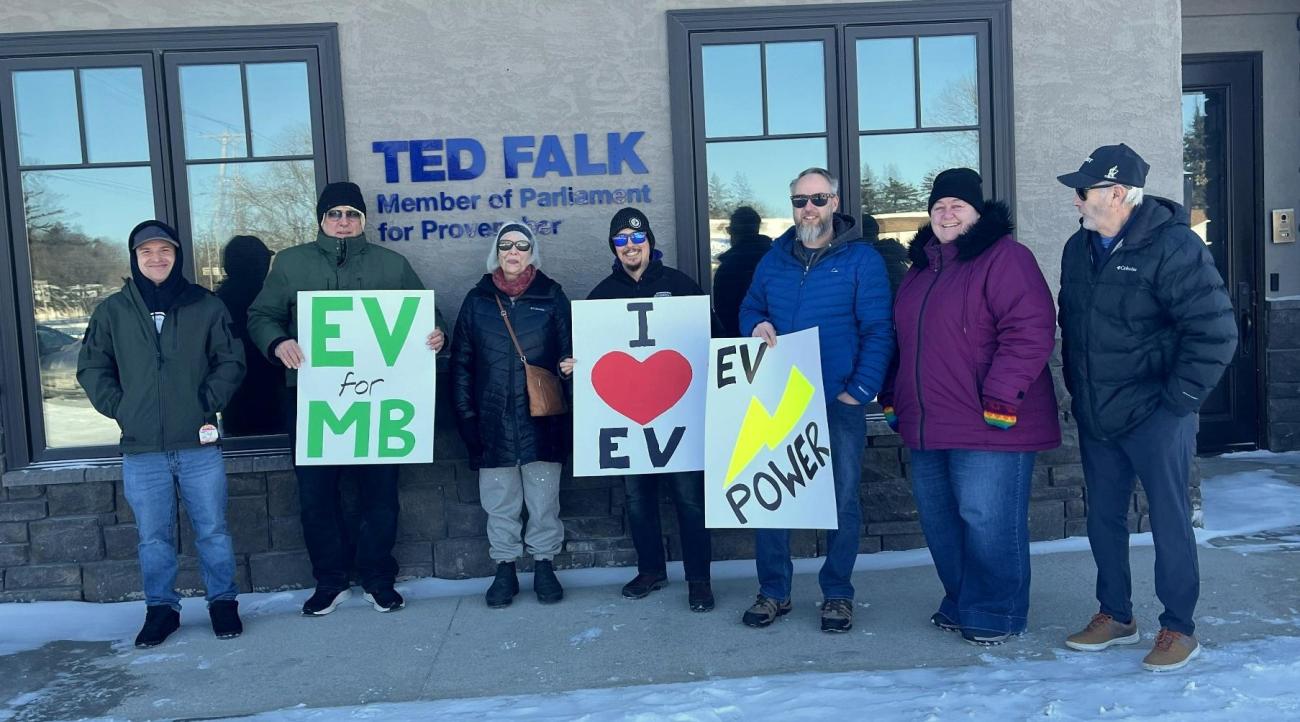
It was minus-20 degrees with drifting snow on February 22 at noon. In a Steinbach parking lot in front of MP Ted Falk’s constituency office, a group of eight fully electric vehicles (EVs) and their passengers gathered. Among them were Trevor Kirczenow and Blair Mahaffy, both of whom ran against Falk in the last federal election, Kirczenow for the Liberals and Mahaffy for the Greens.
The pair had called this impromptu gathering for a very specific reason: to demonstrate the practicality and benefits of EVs in response to a flyer sent out by Falk in August 2025. According to Kirczenow and Mahaffy, the mailer implied that EVs are impractical in cold climates.
They say that the same flyer and sentiment has circulated through other PC ridings, but they’re not sure just how far the message has spread.
“That’s not just one guy’s opinion anymore,” Mahaffy says. “That’s an advertising campaign against EVs.”
The Citizen reached out to Falk for a response to what some feel is an anti-EV message.
“I’m not opposed to electric vehicles,” Falk said. “I’m opposed to the 2035 EV mandate. This should be about individual choice. EVs may work well for some people, but in our winter climate battery performance can drop significantly, in some cases upwards of 50 percent. People should have the freedom to decide what works best for their families, their businesses, and their livelihoods.”
Meanwhile, as the small crowd enjoyed a chilly afternoon in that Steinbach parking lot, sharing stories of their EVs, there were no emission clouds hovering over them, even while the vehicles sat running to keep their interiors warm and toasty.
2035 EV Mandate
The 2035 EV mandate referenced by Falk was retracted by Carney’s Liberals just this month. It began as a plan by Prime Minister Justin Trudeau to ensure that, by 2035, all light-duty vehicles sold in Canada had zero emission capability.
According to Mahaffy, many people, including Falk, seem to have some misunderstandings about that mandate—and about EVs in general.
“People got it into their head that, as of that date, they were going to have to buy an EV,” says Mahaffy. “That’s not what that was. It was that any new car sold after that date had to be electrified in some way, whether a pure battery EV, a [gas] hybrid, or a plug-in hybrid. You could still buy used gas cars.”
The ongoing spread of misinformation like this, according to Mahaffy and Kirczenow, is the primary reason for the slow uptake of EVs in Manitoba.
They add that this idea of battery performance dropping by half in cold weather is also a misconception. Both are owners of fully electric vehicles and both live in rural Manitoba, Mahaffy as far east as West Hawk Lake. Both use their EVs to commute in every driving condition.
“There’s no doubt that you lose range in the winter, for sure,” Mahaffy says. “That just means you have to think about [your trip] a bit. If I have to stop for 10 or 15 minutes to get a charge, big deal. I get a cup of coffee and chill.”
Where he gets 550 kilometres on one charge in summer, it’s more like 300 in winter. Even with a 300-kilometre range, though, he can drive to Winnipeg, run errands all over the city, then drive back to West Hawk without stopping to charge.
When he does charge it at home, it costs him around $10 in electricity compared to what might be $100 at the pumps.
Comparison Points
Where EVs outperform gas-powered vehicles in winter is their ability to start easily in the cold. There are also only a fraction of mechanical parts at risk of breaking down when it’s minus-40 Celsius.
“An EV has about 20 moving parts and a gas vehicle has over a thousand,” Mahaffy points out.
EV drivers are also learning to appreciate their high-energy batteries for other reasons. With the use of a simple adaptor, the EV battery can power regular electrical appliances while on the road.
This was demonstrated at the EV gathering in Steinbach as the group enjoyed hot chocolate from a kettle heated on an induction stove plugged into one of the car’s batteries.
“Try putting that on your V6 block,” Mahaffy laughs. “It’s totally fun and totally nerdy.”
There are EV trucks, he adds, that come equipped with 110-volt outlets so construction workers can run power tools from the box.
Long-Distance Driving
As for long-distance road trips, Mahaffy’s family drove the EV as far as Vancouver Island last spring. It’s the kind of thing you plan for, he says, as you would with any big road trip.
Typically, stops at a rapid charger along route will add a couple of extra hours to your drive. Mahaffy enjoys this downtime from inside the comfort of his vehicle, catching up on emails or reading a good book. It’s a good time to grab a coffee or a meal, or even take a nap before hitting the road again.
More and more of Canada’s national parks are providing charging stations at their trail heads, too, giving people the opportunity to stretch and enjoy a hike while their car charges. It’s part of the adventure, Mahaffy says, as long as you choose to see it that way.
EV Infrastructure
“Instead of saying EVs are impractical, what I would like to hear from someone like Ted Falk is, ‘These are great vehicles and I would support having more infrastructure around southern Manitoba,’” Kirczenow says.
As for infrastructure, it’s about more than just increasing the number of charging stations across the province and country. For Mahaffy, it’s also the facilitation of Canadian-owned battery recycling facilities to help establish a full-loop system which ensures the lowest possible environmental impact.
“I’ve heard that there are three companies in North America that recycle EV batteries,” says Mahaffy. “They claim that they can recover up to 95 percent of the materials and put them into new batteries. When you can extract the materials out of that battery, you’re pretty much not having to dig up new resources anymore.”
What’s often missing from the messaging, as well, is the value that used EV batteries pose for anyone running a solar system and needing low-energy storage options.
“The demands on the battery are super intense in an EV,” Mahaffy says. “Whereas, for grid and household use, it’s more of a trickle.”
“I think for me and Blair, just having the conversation is really important,” Kirczenow concludes. “Conversation is such an important part of our democracy, and I’d like to see that stronger, specifically in Provencher.”
Gas Price Volatility
With another war raging in the Middle East, causing gas prices to surge, it’s become increasingly volatile to count on crude oil imports in a country like Canada that’s looking to create economic sustainability.
At the pumps, in just a few short weeks, Manitobans have watched gas prices jump by about one-third.
This is a predicament not shared by EV drivers.
Tough times like these, along with the fresh availability of federal EV rebates, might just turn the tide for electric vehicle adoption in Canada.
“I have had an EV for more than a year now and have been thrilled with its performance through all four seasons,” says Paul Lavin of Niverville. “Now, as gas prices rise, I also feel quite a bit of gratitude for the fact that my car has a full charge every morning and I don’t have to think about the cost of gas today or how high it might get tomorrow.”