

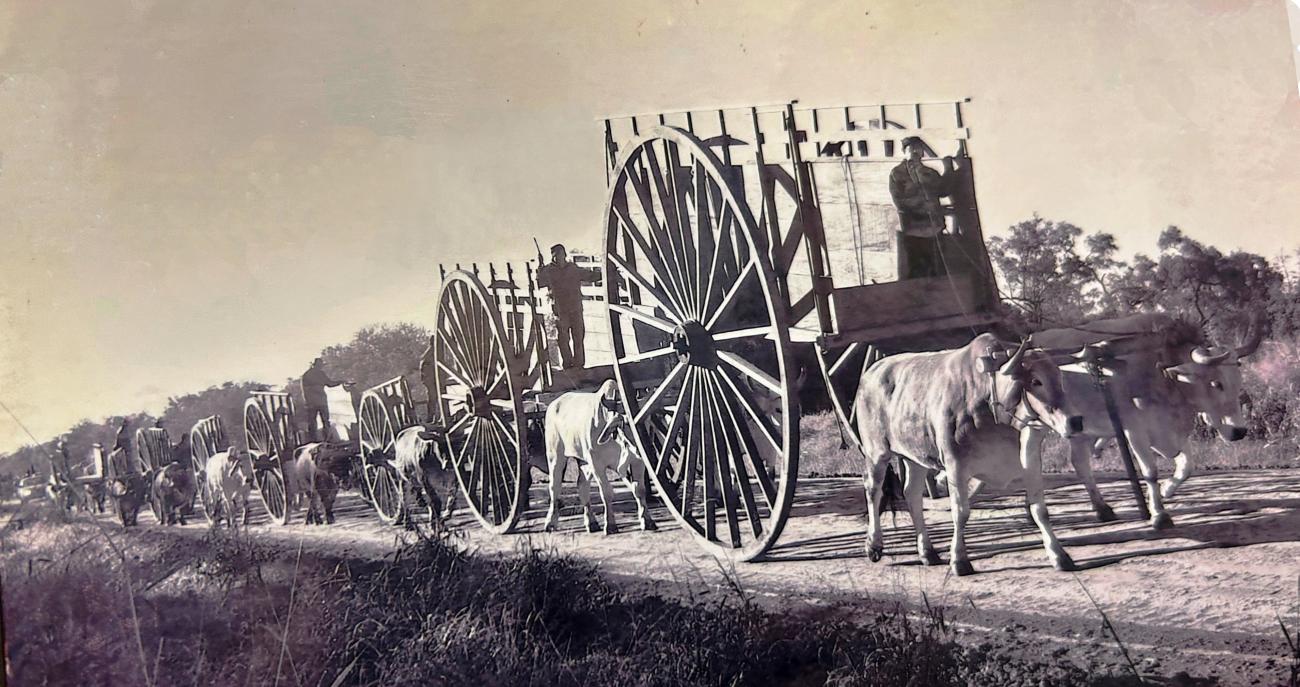
This year marks the one hundredth anniversary since Manitoba Mennonites left to seek cultural freedom half a world away in Chaco, Paraguay. In honour of the momentous event, the Chortitz Church Committee is hosting a commemorative gathering at the Chortitz Heritage Church in Randolph on April 12.
In many ways, the 2026 gathering is being planned to mirror the send-off held for departing families in the fall of 1926.
Local Mennonite historian Ernest Braun will provide a detailed telling of the events that led to the migration, the hardships they faced, and the repercussions of that portentous decision.
“They had a farewell service in the Grunthal Chortitz church,” Braun says. “The whole yard was swarming with people and they could only fit a fraction of them into the church. Martin C. Friesen, who was the bishop at that time, read Psalm 121 as a blessing on that migration.”
This biblical passage will find renewed relevance at the gathering in Randolph in April. As well, attendees will enjoy congregational singing in both English and German to the accompaniment of a Paraguayan harp. Faspa will follow.
An invocation will be given by Reverend John B. Wiebe, whose mother was among the first of the families who departed for South America.
Thanks to journals and generational stories, the events of the Paraguayan migration live on with great detail and nuance. Hundreds of families left for Minneapolis by train, then headed for Chicago and finally New York City. Here, they embarked on an almost month-long journey on a freightliner.
The first wave included 51 families. Over the next nine years, more followed. In total, more than 300 Manitoba families, consisting of nearly 2000 individuals, put down roots in Paraguay.
Braun’s father was also among the first wave, travelling as an 11-year-old with his family. Braun’s grandmother died shortly after their arrival in Paraguay, though, leaving his grandfather to the difficult task of settling the new land with six young children.
In the years that followed, some families returned to Manitoba, resettling in communities throughout the rural southeast. The majority remained.
What drove them to leave in the first place was a determination to get back to deeply held ideals that were slowly being eroded under Canadian law in the early twentieth century. Primarily, they desired to educate their children in German and under the Mennonite faith without interference from the outside world. They also wanted the right to refuse to take up arms.
Similar precepts had led them to Manitoba from Russia, but 40 years later, in 1907, all Manitoba schools were required to fly the British colonial flag. For Mennonites, this challenged their desire to remain separate from nationalism and militarism.
By 1916, well into World War I, a general disdain grew amongst Canadians for all things German. This intolerance led the federal government to rule in favour of eliminating all non-English curriculum in schools.
By 1918, private schools like those run by the Mennonites were forced to close. Fines were issued to anyone refusing to send their children to public school.
“One guy from Altona actually ended up spending 20 days in jail because he refused to send his kids to school,” says Braun. “He actually became one of the delegates later on to go to Paraguay.”
Paraguay was far from the first choice for local Mennonites. Delegates were sent to investigate destinations offering farmland, isolation, and freedom from government interference. According to Braun, they considered northern China, northern Africa, the United States, and other countries in South America.
A series of unexpected events and meetings led one delegate to Paraguay. He sent back a telegram stating, “I have found the promised land!”
But there were two major problems. The land available to Mennonites in Paraguay hadn’t been surveyed. As well, about a hundred kilometres of swamp lay between the river on which they’d arrive and the settlement area.
Paraguayan officials made a promise to survey and provide legal title for the land if the Mennonites came. By the time of their arrival, there was to be a railway connecting their land to the riverfront.
Unfortunately, the economic crash of 1921 prevented the Mennonites from departing for Paraguay. Farm commodity prices collapsed and didn’t bounce back until 1926. Mennonite farmers then traded their Manitoba land for plots in Paraguay, using any remaining profits to purchase transport for their family.
They arrived in Paraguay with a few belongings and little else. What they discovered was that the Paraguayan government had failed to fulfill their part of the bargain. The land still hadn’t been surveyed and no railway had been built.
“Can you imagine taking your family, with little kids and babies, and all your possessions on a cart with 12-foot wheels, going through five feet of water for 100 kilometres?” Braun says.
The death rate among these first arrivals was high, especially children. The Mennonites, says Braun, were a moderate climate people. They had little tolerance for the extreme temperatures of this tropical climate or the unbearable insects.
They also had little understanding of the need to boil water for its safe use, leading many of them to contract life-threatening diseases.
“They had vaccinations available to fight typhoid fever, but Mennonites refused to accept them,” Braun says. “Still, the Paraguayan Mennonite colonies have been enormously successful. They send their kids to university in Switzerland and Germany. They produce the greatest amount of milk in the entire country, and they have their own factories. They are ingenious and entrepreneurial and progressive.”
To this day, the Mennonites of Paraguay enjoy the freedom to educate their children according to their faith and in the German language.