

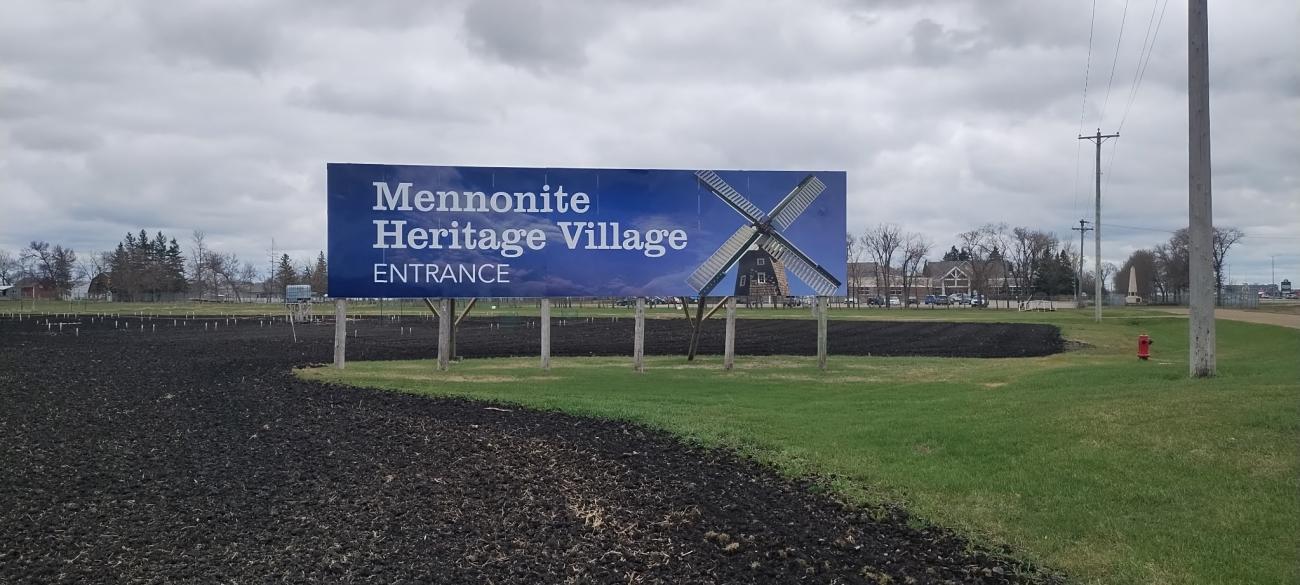
Beginning May 23, history lovers can take a trip through time to discover the medicinal practices and healing techniques used by early Mennonites over the centuries.
Hosted at the Mennonite Heritage Village (MHV), the exhibit is called Mennonite Medicine Cures and Curiosities. Covering 150 years, from 1800 to 1950, guests to the exhibit will see displays and artifacts of ancient practices such as bloodletting. They’ll journey through time to meet the notable names in medicine, both certified and self-appointed.
Garth Doerksen is the senior curator at the MHV and was instrumental in bringing this new exhibit together. Artifacts, such as medicinal herbs, have been brought in from sources like the University of Manitoba’s herbarium. As well, herbal books and diaries have been located that date back as far as the sixteenth and seventeenth centuries.
“Jacob Wiens wrote a diary and it includes about 15 different herbal medical recipes,” Doerksen says.
The artifact that perhaps holds the most curiosity, though, is located early in the exhibit.
“The very first item when you walk into the gallery is a large apothecary bottle, probably two feet tall, and we know that it belonged to Katherina Thiessen,” says Doerksen. “She was a well-known midwife trained in Germany. She went to the U.S. for a while and then landed up in the Winkler area. The local clinically trained doctors didn’t like people like her. A few of them were taken to court.”
The bottle on display is still sealed, containing a liquid of unknown origin. Attendees will have a chance to register their guesses as to what the contents may be.
Of course, throughout most of the twentieth century, a bottle of Wonder Oil was a staple in just about every Mennonite medicine cabinet. Over the decades, this Winnipeg-based product garnered a reputation in rural Manitoba as something that had merit for virtually any malady, taken either internally and externally, by either human or beast.
“There is a Niverville story [including] a veterinarian by the name of John Harrison who some of the Mennonites went to for [personal] medical help,” Doerksen says. “There’s actually an article in the Manitoba Free Press that dates back to about 1905 that criticizes the Mennonites for that.”
There are displays covering the Mennonites’ response to epidemics such as smallpox of the nineteenth century and the Spanish flu of the early twentieth century. It also tells how some early Mennonites joined the medical corps in order to do their part during wartime.
“In the Crimean War in the 1850s, the Mennonites felt obliged to help contribute to the imperial Russian cause, but they also felt conflicted by their pacifistic stance. We talk about how they wrestled with that.”
Of course, having a clean bill of health was likely never more important to the Mennonites as it was during their immigration to North America. Medical issues prevented many from joining their family for the journey. Others were held back prior to boarding a ship. As a result, Doerksen says, there are plenty of heartbreaking stories of families separated.
The historical exploration continues into the twentieth century, as Mennonites undertook training in North American practices as doctors and nurses.
“There was a Helena F. Reimer [of Steinbach] who actually won the Order of Canada. She worked for the World Health Organization and had quite a remarkable career. She worked in quite a few places throughout the world.”
The early twentieth century also included the construction of the Bethesda and Concordia Hospitals. Artifacts are on display which include a baby weigh scale and bassinets used in the early maternity wards of Bethesda.
The exhibit comes to a close with a look back at life-altering conditions and curious medical occurrences. Doerksen shares two such stories that can be found there.
One is of a 38-year-old Mennonite farmer who was rendered blind after a botched eye surgery. Sometime later, his sight was miraculously restored when he banged his head on a wooden beam. His cure was never explained.
Another is the story of Peter Dyck from the Carmen area.
“He had an accident where he broke his back and was paralyzed from the waist down. He had a bed made for him where he could lie flat on his stomach. It was motorized so he could spin around the countryside. There’s a picture [showing it with] headlights and large bicycle tires.”
Over the centuries, it’s clear that worldly medical practices eventually infiltrated the Mennonite experience. But the most significant influencer of their medical approach was probably their faith.
“There’s a German word called Gelassenheit, which is a handing over of one’s health and all aspects of life to God,” Doerksen says. “Whatever is God’s will, we as a people embraced that.”