

When it comes to pushing us to have hard but necessary conversations, sometimes it’s the youth who guide us. That truth was nowhere more evident than at the New Bothwell Recreation Centre on May 15–16.
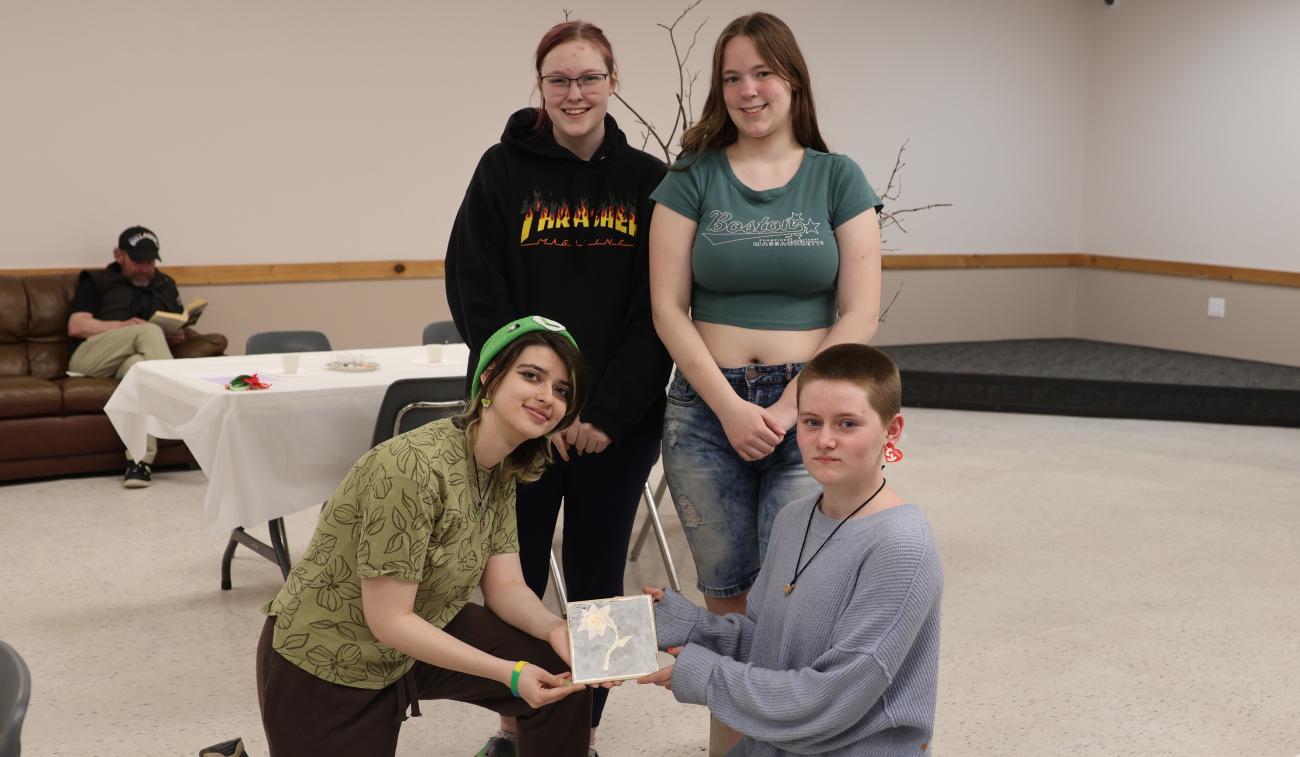
Four local young people gathered for The Tile Project, a mental health awareness campaign created to open up the conversation while raising money for the Suicide Crisis Helpline.
Morgan Dauphinais, Ciara Fehr, MJ Ascough, and Gray Kehler are 17-year-old friends who go way back, some of them as far back as Kindergarten.
Just over two years ago, the quartet lost their good friend Alisha to suicide.
Alisha was only 16 when their life was cut short. Since that time, the group has been looking for creative ways to keep Alisha’s memory alive and bring some lasting purpose to what happened.
Thus was The Tile Project born. Over the May long weekend, friends, family, and community members were invited to join them in painting tiles which will become part of a greater mosaic, to be erected somewhere in New Bothwell.
“About a year ago, we started planning this,” says MJ. “We wanted to do something to remember [Alisha] by. And we wanted people to know that they’re not alone and they have a place. We are here to give a message of hope and love and community.”
The group supplied the tiles and paint, as well as a single leafless tree in the middle of the recreation hall. Attendees were able to place messages of hope on its branches.
Almost all of the project’s four initiators have firsthand experience of suicidal ideation and mental health struggles, whether personally or in their family.
For MJ, it’s what brought her to Bothwell School a few years back, after being bullied in her former school. In Bothwell, she became fast friends with Alisha and the others.
For the first time in a long while, she felt safe. With counselling and the support of parents who work in the field of mental health, she was able to access the resources she needed to prevent her from going down a very dark path.
“So many teenagers go through this and they don’t know who to talk to or where to go,” MJ says. “But someone in your world loves you. They will miss you. There are little things that you do that they will miss. It is not worth it to go away.”
The group wishes their friend Alisha had found someone to confide in.
“I want to make sure that people know they can talk to anybody about this,” Morgan says. “They don’t know how people will respond, but they should just reach out, even if they don’t know the person.”
According to Ciara, though, part of the problem for those who struggle is the pervading stigma that a young person’s cries for help are merely attention-seeking tactics to bolster their ego. This is how quiet cues get missed, she says, and then it’s too late.
Each of the friends agree that mental health struggles feel more prevalent in their generation. This could in part be due to their intense connection to the world through social media, where they’re daily exposed to crises in economics, politics, and the environment.
“[This stuff] is pushing down on us, which causes a lot of us to snap,” Morgan says.
Due to online connections, they add that their generation’s peer groups are also much larger, giving them a broader perspective of the teenage experience. This has even been advantageous in a few ways.
“I think our generation has [been more effective in] pushing for equality, kindness, understanding and empathy,” MJ says.
But until suicide is no longer an option sought by mental health sufferers, this group will soldier on and keep the conversation going.
If you have concerns for someone else’s well being, the friends insist that these cues must never be ignored. Their advice is to inform a trusted adult or parent, and then point them in the direction of the resources and help lines available.
“The more we talk about this issue, the more people will find ways to help one another,” says Morgan.
FOR MORE INFORMATION
- Instagram: thetileproject2026
- To access help: Southern Health-Sante Sud Crisis Line (1-888-617-7715), Suicide Crisis Helpline (call or text 988), Kids Help Phone (1-800-668-6868, or text CONNECT to 686868), Manitoba Suicide Line (1-877-435-7170).