

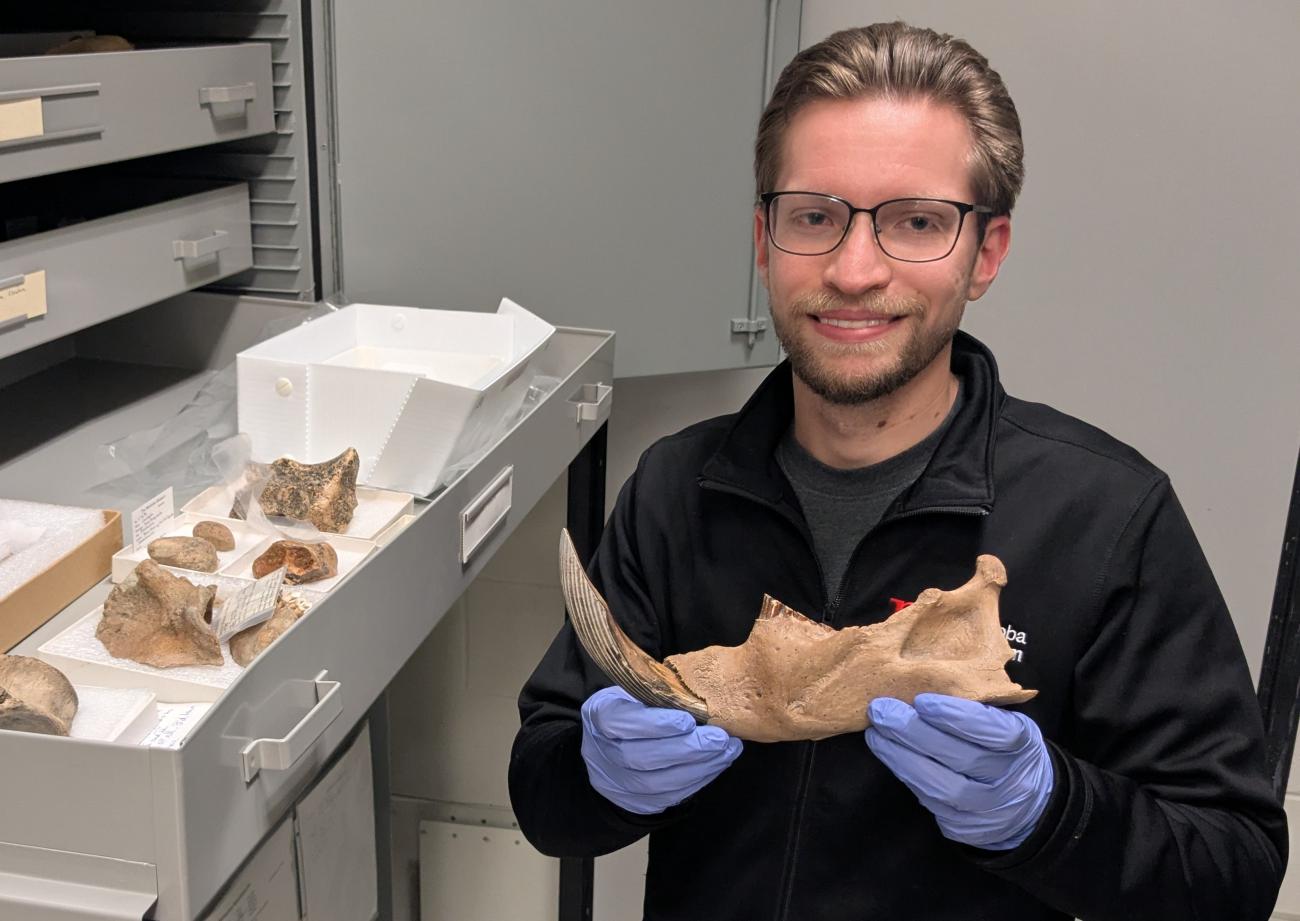
In recent years, curious finds by quarry workers in gravel pits near Grunthal have led to some remarkable discoveries about prehistoric conditions in southeast Manitoba.
According to Dr. Joe Moysiuk, curator of palaeontology and geology at the Manitoba Museum, the artifacts date back to the Ice Age, a period believed to have followed the extinction of the dinosaurs but predating humans.
As of December 1, a new exhibit at the Manitoba Museum tells a story based on these findings.
“It’s a mural depicting what life was like in the Ice Ages in Manitoba,” Moysiuk says. “A lot of the fossil evidence that went into creating this mural was found close to Grunthal, so it’s kind of a nice local story.”
Once discovered, the artifacts were turned over to the Manitoba Museum. Scientists were commissioned to study and date them, leading to the conclusion of the historical timeline in which they fall.
“We’ve amassed a bit of a collection from the area,” says Moysiuk. “There are many different bones from animals, mostly mammals. We have things like mammoths and extinct bison species. We also have a very remarkable jawbone from a giant beaver. These are beavers that were about the size of a black bear.”
Also among the finds are evidence of muskox, a species that isn’t extinct but certainly not found in southeast Manitoba today.
Within the deep sediment where the bones were found, scientists have also discovered bits of fossilized pine wood and pollen from plants and trees. All of these things, together, flesh out our understanding of the region’s past ecosystem.
“It’s a really interesting assemblage of fossils and one of the most diverse in the province.”
The relics found here aren’t as old as those found in Morden in past years. According to Moysiuk, the Morden bones date back about 85 million years.
“The material that we’re finding in Grunthal, there’s still work being done to find out how old it is, but we suspect it’s around 40,000 years old.”
There are two primary processes for dating artifacts. One of them is carbon dating.
“The trouble with carbon dating is that it relies on carbon-14, which decays radioactively,” Moysiuk explains. “Unfortunately, the speed at which it decays means that there’s basically none left after about 40,000 to 50,000 years. So it can’t actually date things that are older than that, reliably.”
Moysiuk’s colleagues at the Manitoba Geological Survey are incorporating a more complicated dating process called optical dating.
“The more approaches that we can use to give us information that’s consistent, the more certain that we can be about the age of that material.”
During the time of the Ice Age, Moysiuk says it is believed that ice sheets in southeast Manitoba were more than two kilometres in depth at times.
“Over the course of hundreds of thousands of years, the ice sheets moved back and forth across the province,” he says. “So sometimes they moved out and some of the plants and animals were able to move back into those areas. And then the glaciers would move southwards again and move around a lot of these bones of animals.”
For that reason, it’s difficult to be certain that the Grunthal findings indicate something that was indigenous to the region or simply deposited by the ice movement.
The researchers are confident, though, that the landscape around Grunthal would have been something similar to the boreal forest.
Commissioned to paint the mural for the Manitoba Museum is Julius Csotonyi, a Manitoba native and scientific illustrator. His work is on display at museums around the globe.
The Grunthal artifact mural can be found at the back of the Earth History gallery, behind the iconic giant ground sloth replica. Eventually, Moysiuk anticipates that displays containing the actual Grunthal finds will be located here too.