

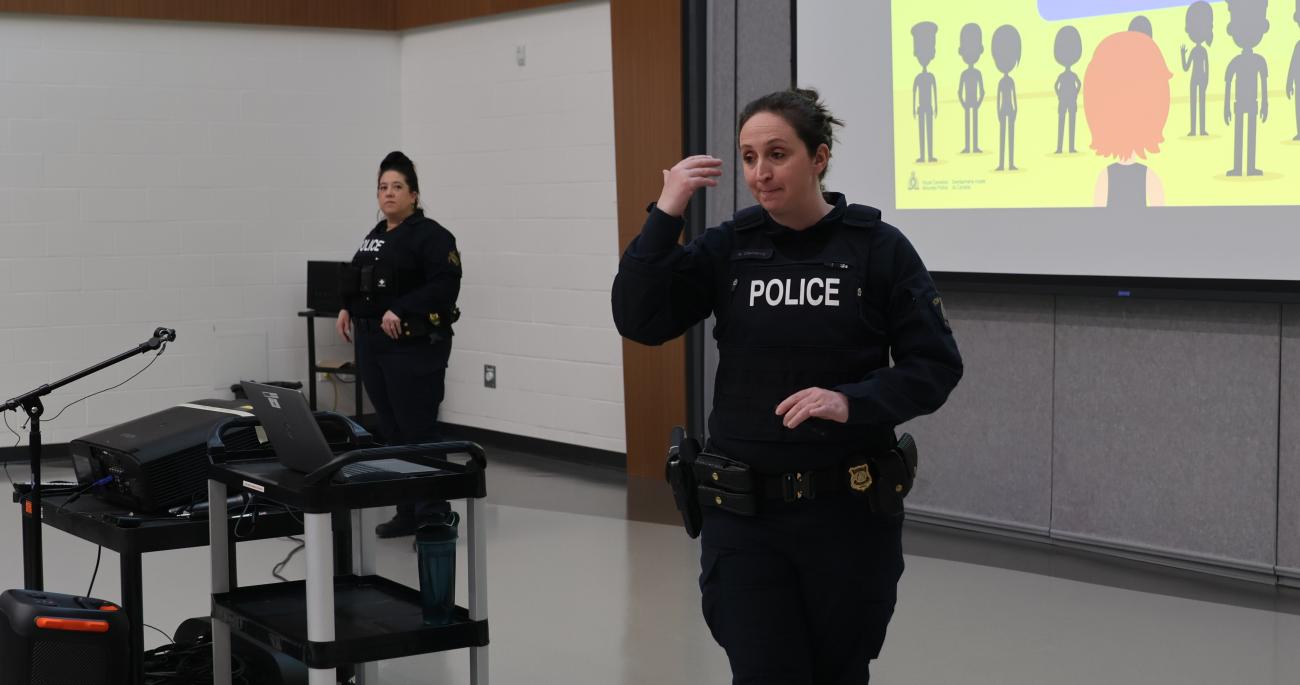
In an effort to promote education about keeping young people safe, the RCMP have been sending officers from the Internet Child Exploitation team to high schools throughout the province.
On April 8–9, Niverville High School students sat in on a series of interactive presentations. Corporal Emmie Clements and Constable Joanie Duguay provided an honest assessment of what they see every day as part of their jobs.
They emphasize that when you share intimate pictures online, even on apps that feel secure, it’s important to understand that they are stored somewhere in cyberspace—and they’re stored indefinitely.
According to Clements, that includes apps like Snapchat, whose whole premise is that shared photos and videos disappear after a brief period of time, ostensibly preventing them from being saved.
Unfortunately, Clements says, that’s not how it really works. She knows this better than most, because investigators like herself work at tracking intimate photos and messages online every single day.
She says there’s a simple rule of thumb to follow to prevent the shame associated with being exposed in intimate ways online.
“Don’t share any pictures that you wouldn’t want your parents to see,” said Clements.
A student in the audience reinforced this message with a personal story. He shared a headshot of himself on an app called Doppelganger where viewers can comment on whether you look like someone famous. Months later, he decided to run a search for his own images online and was shocked to discover that the same candid photo of himself had been picked up and posted on an obscure site created for sexual purposes.
In cases like this, Clements said, even if the shared photo isn’t an intimate one, victims should report it to cybertips.ca. Investigators can ensure that the photo is removed and the site is flagged for its indiscriminate operation.
As well, kids need to keep their social media settings set to private. Passwords should be difficult to hack and shared only with parents. As well, the location tracker on our phones should be turned off.
“There’s websites online, open to the public and not spy software, where I can [find out] your map location, where your privacy settings are set, what you shared, at what time, and [from what] location,” Clements said.
The duo further emphasize the importance of not accepting friend requests from unfamiliar social media accounts.
It’s a well-known practice of predators to send out friend requests to teenagers using fake profiles. Once accepted by one person, the predator has access to every person on that person’s friend list, making everyone vulnerable.
These predators almost always use grooming techniques to coerce intimate photos from their victims. If the victim is female, Clements says the perpetrator will usually blackmail them for more explicit pics. These photos likely end up on child pornography sites.
Male victims are equally at risk of sextortion tactics, she adds. The victim is typically blackmailed by someone posing as a young female in order to gain something of monetary value, like etransfers, gift cards, or gaming tokens.
To send a not-so-subtle message to anyone requesting male genital photos, Clements suggests sending an image of a naked mole-rat, a rodent that bears some likeness to the human appendage. It’s quickly becoming a symbol of non-participation, she said.
If a youth has already shared intimate information, Clements and Duguay say that it’s imperative to block the perpetrator and send them nothing further. Then they should either tell a trusted adult or go to the RCMP.
“You’re not alone,” Duguay said. “If you’re embarrassed, we understand. But we’ve seen it all. For us, it’s our work and we’re here to keep you safe.”
At times, the perpetrator may not be some random stranger online. Clements says they often encounter cases where the offender lives in the same home as the victim.
“If you guys find a camera in your washroom at home, that is not safe,” Clements said. “Report it. Call 911 and someone will show up very quickly.”
They also remind youth that it’s illegal to possess intimate pictures of an underage person on their computer or phone, even if the photos were unsolicited. Sending messages which could be construed as luring is also a chargeable offence, regardless of a person’s age.
“We don’t like to charge people who are under 18,” Duguay said. “We want you to have a good life. But if we have to, we will.”
Sexual offences in Canada, she says, are taken very seriously and follow a person right through their adulthood. Criminal records can prevent a person from ever pursuing jobs where they might be in contact with children. That includes the fields of law enforcement, medicine, and education.